

Early Macular Degeneration: What Are the First Signs?
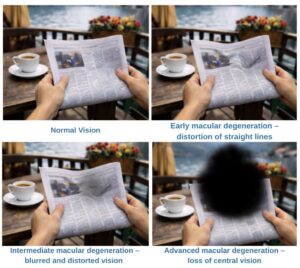
Progression of vision changes in age-related macular degeneration.
From left to right: normal vision, early distortion of straight lines, mid stage blurred and distorted central vision, and late stage loss of central vision.
Age-related macular degeneration (AMD) is a common retinal condition that affects the macula, the central part of the retina responsible for detailed vision used for reading, recognising faces and driving.
In the early stages of macular degeneration, many patients do not notice obvious symptoms. Changes may first be detected during a routine eye examination.
Understanding the early signs of macular degeneration can help patients seek assessment and monitoring before significant vision loss occurs.
What Happens in Early Macular Degeneration?
Early macular degeneration is usually characterised by the presence of drusen, small yellow deposits that form under the retina.
These deposits are made up of cellular waste products that accumulate between the retina and the underlying support layer known as the retinal pigment epithelium.
In many patients, small drusen may not affect vision significantly. However, larger drusen may indicate a higher risk of progression to more advanced forms of macular degeneration.
What are the Early Symptoms of Macular Degeneration?
Some people with early AMD may notice subtle changes in vision such as:
• slightly blurred central vision
• difficulty reading small text
• needing brighter lighting for reading
• reduced contrast sensitivity
• slower adaptation when moving between bright and dim environments
These symptoms are often mild and may develop gradually.
Because the brain can compensate for small changes in vision, many patients do not recognise symptoms until the condition becomes more advanced.
Distortion of Straight Lines
One of the classic early warning signs of macular degeneration is distortion of straight lines – Amsler Grid is often used to monitor for these changes.
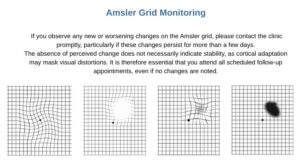
Examples of how an Amsler grid may appear to patients with macular degeneration, including distortion of lines, blurred areas and central vision loss.
Patients may notice that:
• door frames appear slightly bent
• lines on a page appear wavy
• tiles or window frames appear distorted
This distortion can sometimes be detected using an Amsler grid, a simple grid pattern used to assess central vision.
Changes in Reading Vision
Many patients first notice symptoms while reading.
Words may appear:
• slightly blurred
• uneven or distorted
• more difficult to recognise
Patients may also find they need brighter light or that reading becomes more tiring.
Dark or Missing Areas in Vision
As macular degeneration progresses, some patients may develop a small dark or blurred area in the centre of vision.
This may make it harder to:
• recognise faces
• read
• see fine detail
These symptoms should prompt further assessment by an eye care professional.
When to Seek Urgent Assessment
Some symptoms require prompt medical attention.
Seek urgent assessment if you notice:
• sudden distortion of straight lines
• rapid central vision loss
• a dark patch appearing in the centre of vision
These changes may indicate wet macular degeneration, which requires urgent treatment.
Why Regular Eye Examinations Matter
Early macular degeneration is often detected during routine eye examinations, even before symptoms develop.
Eye care professionals may identify early AMD using:
• retinal examination
• optical coherence tomography (OCT)
• retinal photography
Regular eye checks are particularly important for people over the age of 50 or those with a family history of macular degeneration.
Managing Early Macular Degeneration
Although early macular degeneration may not require immediate treatment, several strategies may help reduce the risk of progression.
These may include:
• regular monitoring
• lifestyle and dietary changes
• nutritional supplementation in selected patients
• early detection of progression to wet macular degeneration
Your ophthalmologist or optometrist can guide appropriate monitoring and management.
Macular Degeneration Care in Sydney
Macular degeneration requires careful monitoring and accurate diagnosis.
At Eye & Laser Surgeons, patients undergo detailed retinal imaging to assess the stage of macular degeneration and determine appropriate management.
Dr Shanel Sharma and Dr Daya Sharma are specialist ophthalmologists who assess and manage patients with macular degeneration.
Frequently Asked Questions
What are the earliest signs of macular degeneration?
Early signs may include blurred central vision, distortion of straight lines, difficulty reading and needing brighter lighting.
Can macular degeneration start without symptoms?
Yes. Early macular degeneration may be detected on retinal examination before noticeable vision changes occur.
Does early macular degeneration cause vision loss?
In many patients early AMD does not cause significant vision loss, but monitoring is important because the condition can progress over time.
How is early macular degeneration detected?
Early AMD can be detected using retinal examination, OCT imaging and retinal photography during an eye examination.
Find out if you are suitable for vision correction
Not everyone is eligible for vision correction surgery.
Find out if you could benefit from this life changing surgery by taking the quick self-suitability quiz below: