

Wet Macular Degeneration

Early care for wet macular degeneration to help protect sight

Wet Macular Degeneration

Glamorous older adults playing bridge, representing central vision and reading difficulties from wet macular degeneration

Wet macular degeneration, also called wet AMD or neovascular age-related macular degeneration, is an urgent form of macular disease that can cause sudden distortion, blurred central vision or rapid loss of reading vision. At Eye & Laser Surgeons in Sydney, Dr Shanel Sharma assesses and manages wet AMD using careful eye examination, OCT macular imaging and, when needed, anti-VEGF injections. These intravitreal injections help control the abnormal leaking blood vessels that cause fluid, bleeding and swelling under the macula. Therefore, early diagnosis and ongoing monitoring are important. With timely treatment, many patients can stabilise their vision, reduce macular fluid and lower the risk of further central vision loss. Patients with wet AMD who also have cataracts may also need personalised cataract surgery planning, because the final visual outcome depends on both the cataract and the health of the macula.


Discover how wet macular degeneration is treated and why early action matters

Find out how wet macular degeneration develops and the treatments that help protect sight.
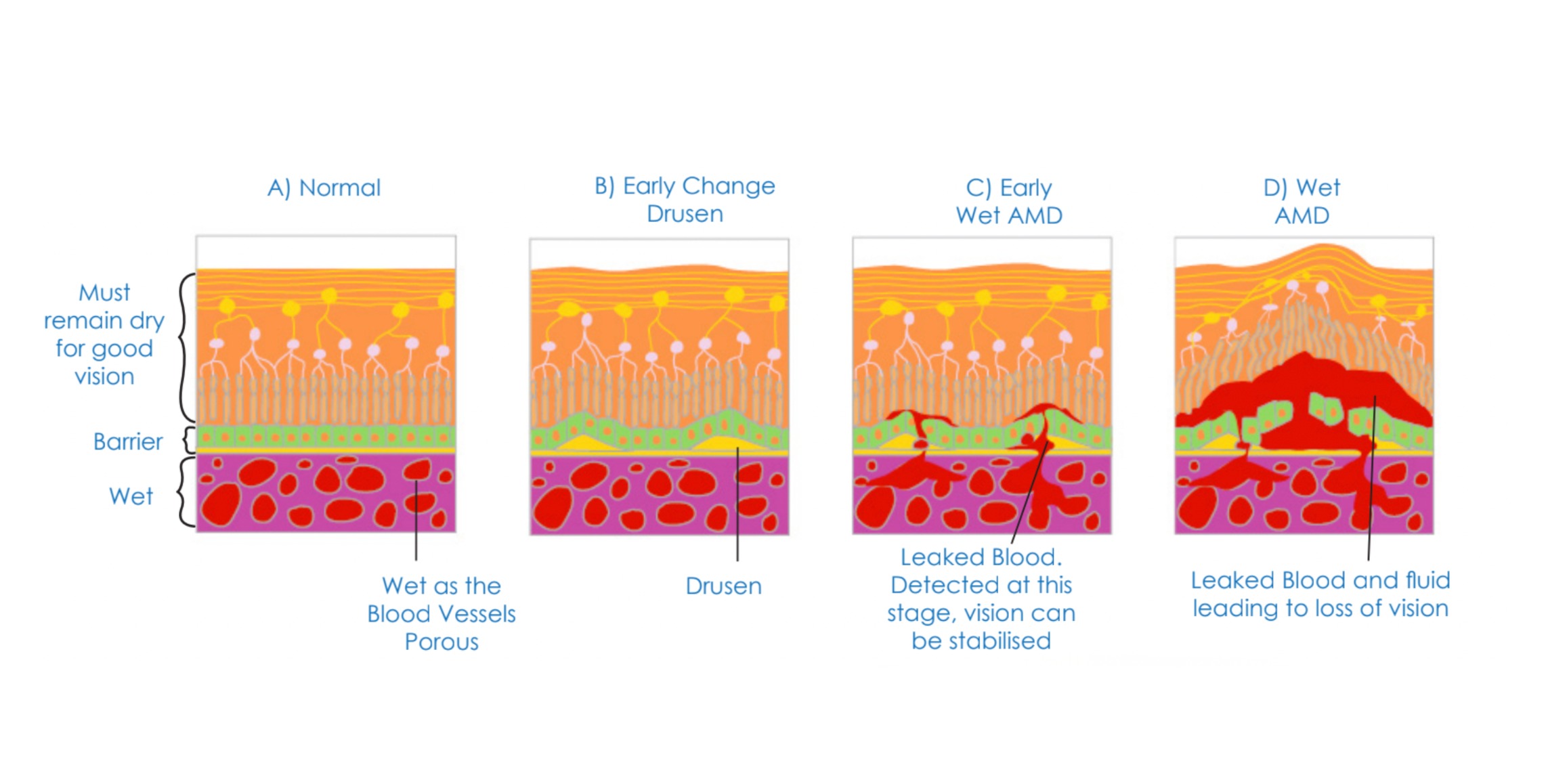
Wet macular degeneration occurs when the Choroidal blood vessels that are porous by nature, grow through Bruch’s membrane and leak fluid, lipid or blood into the retina.

The macula controls detailed central vision. Therefore, wet AMD can affect reading, driving, recognising faces and seeing fine detail. However, peripheral vision usually remains better than central vision.

Wet AMD needs prompt assessment because treatment works best when the disease is detected early. Wet AMD can cause rapid vision loss but may be treated with medications known as anti-VEGF injections. In many patients, anti-VEGF injections can stabilise vision, reduce macular fluid and sometimes improve vision.


Patients with wet AMD may notice:

  • straight lines looking bent, wavy or distorted
  • sudden blurred central vision
  • a dark or grey patch in the centre of vision
  • difficulty reading despite good lighting
  • trouble recognising faces
  • new distortion on an Amsler grid
  • a sudden difference between the two eyes

Importantly, wet AMD can progress quickly. Therefore, new distortion or sudden central blur should prompt urgent eye assessment. If you have these symptoms

Book a Macular assessment Now

Eye and Laser Surgeons — Bondi Junction & Miranda

Bondi Junction: (02) 9387 5300
Miranda: (02) 9531 5300
Email: reception@eyeandlaser.com.au

Dr Shanel Sharma assesses wet AMD by combining symptoms, clinical examination and retinal imaging. First, she checks vision and examines the macula. Then, retinal imaging helps confirm whether fluid, bleeding or active leakage is present.

Testing may include:

  • OCT imaging to detect fluid and swelling in the macula
  • retinal photography to document bleeding, pigment change or scarring
  • OCT angiography or fluorescein angiography, when needed, to assess abnormal blood vessels
  • review of the other eye, because AMD often affects both eyes over time

OCT is particularly important because it helps diagnose macular disease and monitor the response to treatment. Macular Disease Foundation Australia describes OCT as a standard procedure in diagnosis and ongoing management of macular disease.

Treatment usually involves anti-VEGF injections.

Regular monitoring with retinal imaging is typically required.

Anti-VEGF injections are the main treatment for wet AMD. VEGF stands for vascular endothelial growth factor. In wet AMD, VEGF contributes to abnormal blood vessel growth and leakage. Anti-VEGF medicines block this signal.

As a result, treatment can reduce macular fluid, slow disease activity and help protect central vision. Some patients improve. Others stabilise rather than improve. Either way, the goal is to prevent avoidable loss of reading and central vision.

Anti-VEGF treatment usually requires repeated injections. The exact schedule depends on the activity of the disease, OCT findings, vision, response to previous injections and the medication used. The American Academy of Ophthalmology notes that anti-VEGF treatment stabilises vision in most people.

An anti-VEGF injection is also called an intravitreal injection. The medicine is placed into the vitreous cavity of the eye.

Before the injection, the eye is cleaned carefully and numbing drops are used. Then, Dr Shanel Sharma delivers the medication.

After the injection, the eye may feel gritty or watery for a short time. However, patients should seek urgent advice if they develop the following symptoms which can indicate infection :increasing Pain, worsening Redness, increasing light Sensitivity or reduced Vision after an injection.  (RSVP)

Wet AMD is not usually a one-injection problem. Instead, it behaves like a chronic retinal disease that requires monitoring and repeated treatment.

OCT scans help guide treatment intervals. If OCT shows recurrent fluid or new activity, treatment may need to continue more frequently. However, if the macula remains dry and stable, the interval between injections may sometimes be extended.

This is why follow-up matters. Missing appointments can allow fluid or bleeding to return before the patient notices symptoms.

Cataract surgery & wet macular degeneration

Many patients with wet macular degeneration also develop cataracts. Cataract surgery can still help selected patients with AMD, but the expected improvement depends on both the cataract and the macula.

Cataract surgery can improve brightness, glare, contrast and the clarity of retinal imaging. However, it cannot reverse macular scarring or permanent central retinal damage from advanced AMD. Therefore, the safest approach is a careful pre-operative macular assessment before choosing a lens implant.

For patients with wet AMD, Dr Shanel Sharma and Dr Daya Sharma can coordinate care so that cataract planning accounts for:

  • current wet AMD activity
  • OCT findings
  • recent anti-VEGF injection timing
  • the risk of limited reading vision from macular damage
  • lens implant choice
  • realistic expectations after surgery

FAQ

Anti-VEGF injections are the main treatment for wet macular degeneration. They reduce the abnormal blood vessel leakage that causes swelling and bleeding under the macula.Anti-VEGF injections are the main treatment for wet macular degeneration. They reduce the abnormal blood vessel leakage that causes swelling and bleeding under the macula.

Most active wet AMD needs anti-VEGF injections. However, the number and timing of injections depends on OCT findings, vision, disease activity and response to treatment.

Book a Macular assessment Now

Some patients improve after anti-VEGF treatment. Many others stabilise. The most important goal is to reduce the risk of further central vision loss.

Some patients with wet AMD can have cataract surgery. However, the macula needs careful assessment first. Cataract surgery may improve brightness, glare and contrast, but it cannot reverse permanent macular damage.

Dr Shanel Sharma & Dr Daya Sharma assess and manage retinal eye diseases, including wet macular degeneration, and performs intravitreal injections.

GAIN VISUAL FREEDOM IN 3 EASY STEPS

Eye treatment options can be confusing, we’ve made the path to healthier vision easy to follow

STEP 1: GET IN TOUCH

Every eye is different, and early assessment is essential when it comes to macular degeneration. The first step is to arrange a comprehensive eye examination so we can understand your symptoms and assess your retinal health. Call our caring team or use our online calendar to book your appointment.
STEP 2: WE’LL ASSESS & PLAN

During your visit, we’ll carry out detailed diagnostic tests to confirm whether macular degeneration is present and determine its stage. We’ll explain your diagnosis clearly, create a personalised treatment and monitoring plan, and work with you to protect your vision for the future.

STEP 3: ONGOING CARE & SUPPORT

Managing macular degeneration is an ongoing journey. With regular monitoring, tailored treatment, and expert guidance, we’ll work together to help maintain your vision, support your eye health, and give you confidence in your long-term care.


Take the first step toward clearer, healthier vision

Book an appointment to learn more about your eyes and the treatment options that may suit you

Take the first step toward clearer, healthier vision

Book an appointment to learn more about your eyes and the treatment options that may suit you

Dr Shanel Sharma ophthalmologist in Sydney providing wet macular degeneration and anti-VEGF injection care

Hi, I’m Dr Shanel Sharma

I’m an ophthalmologist with subspecialty training in paediatric eye conditions, strabismus, medical retina and general ophthalmology from leading hospitals in Sydney and London, including Moorfields Eye Hospital. I hold a Fellowship with RANZCO and have published widely in peer-reviewed journals. My focus is providing careful, individualised care using evidence-based treatments. I’m accredited to treat a range of conditions and perform procedures including intravitreal injections, strabismus surgery and botulinum toxin treatments. I always aim to make the process clear, calm and supportive.

Hi, I’m Dr Daya Sharma

I’m a cataract, corneal and refractive surgeon with subspecialty training from Moorfields Eye Hospital in London and Sydney Eye Hospital. I perform laser vision correction procedures, refractive lens surgery, and advanced cataract surgery using the latest diagnostic and surgical technology. My work is focused on helping people reduce their dependence on glasses and improve their quality of vision at all distances. I’m actively involved in research, publication and surgical education, and I take pride in offering honest, thorough guidance to every patient. My approach is personal, careful and always tailored to individual needs and lifestyles.