
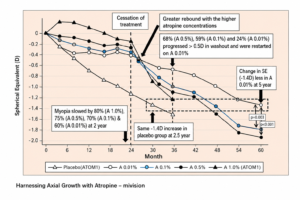
Long-term data from the ATOM studies
Myopia Rebound: Why Vision Can Get Worse Again
Myopia rebound refers to an increase in myopia progression after stopping treatment. It can occur when underlying eye growth is still active, particularly in children and adolescents.
Introduction
Many parents assume that once treatment starts, the problem is “fixed”.
In reality:
- myopia management slows progression
- it does not stop the underlying growth process completely
What is Myopia rebound?
Myopia rebound is when the axial length increases & vision begins to worsen again after treatment is reduced or stopped.
This most commonly occurs with ceasing Atropine therapy.
Why does Rebound Happen?
The key issue is: the underlying driver axial elongation of the eye may still be active
Treatment works by reducing this growth signal.
When treatment stops: the original stimulus may return
Atropine & Rebound
Rebound is most commonly discussed with atropine therapy.
Clinical Insight
- higher concentrations (e.g. 0.05%) in the Atom studies were shown to have higher degrees of rebound.
- Stopping abruptly can increase the risk of rebound
- Gradual reduction is often considered instead
Optical Treatments & Rebound
Rebound may also occur with optical treatments if:
- lenses are stopped too early
- the eye is still actively growing
Learn how these treatments are used in myopia management in children
Timing Matters
One of the most important decisions is: when to stop treatment
Factors include:
- age
- rate of progression
- stability over time
Long Term Management
Myopia management should be viewed as: a long-term process
Not a short-term intervention
Monitoring Is Essential
Regular reviews allow:
- assessment of stability
- adjustment of treatment
- early detection of rebound
Role of Dr Shanel Sharma
Dr Shanel Sharma focuses on:
- monitoring axial length progression
- identifying ongoing risk
- guiding treatment duration and tapering
The goal is to reduce progression without triggering rebound
Understanding rebound is important when considering newer options.
Learn about new myopia treatments.
Long-Term Treatment options
Once myopia is stable:
- the focus shifts from progression to vision correction
- Explore myopia and vision correction
Role of Dr Daya Sharma
Dr Daya Sharma focuses on:
- assesses stability
- advises on timing of correction
- performs laser vision procedures when appropriate
If you are thinking of Vision correction for myopia: try our online vision correction suitability self test.
Concerned About Myopia Getting Worse Again?
If your child’s vision has started to change again, review is important.
- Book an assessment at Eye and Laser Surgeons
- Bondi Junction & Miranda