
Myopia in Children Sydney | Assessment & Early Detection
Myopia in children is caused by excessive eye growth (axial elongation). Early assessment helps detect progression and allows intervention to reduce long-term risks. Increased exposure to high-lux outdoor light is a key protective factor.
Intro
Myopia (short-sightedness) is increasingly common in children, and for many families, it progresses year after year.
What matters most is not just correcting vision — it is identifying progression early and slowing eye growth.
WHAT IS MYOPIA?
Myopia occurs when the eye grows too long, causing light to focus in front of the retina.
In children, this is typically due to progressive axial elongation, not a stable refractive error.
Why Early Assessment Matters
The earlier myopia starts, the longer it has to progress — and the higher the risk of long-term complications.
Research shows that myopia progression is driven by axial elongation of the eye, which can be influenced by environmental factors.
Evidence from large population studies and ophthalmic literature shows that increased outdoor light exposure is protective against childhood myopia progression, supporting early assessment and proactive myopia management to reduce long-term axial length growth .
This makes early identification of progression critical.
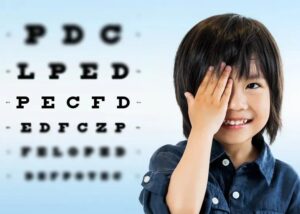
Early assessment helps detect myopia progression and guide treatment.
These risks include retinal detachment, myopic macular degeneration, glaucoma, and earlier cataract.
What Does Assessment Involve?
- Vision testing
- Refraction (cycloplegic when appropriate)
- Axial length monitoring – this is key to treating axial myopia
- Corneal assessment
- Risk profiling (family history + lifestyle)
Evidence: Why Environment Matters
Large-scale studies show:
- Increased time outdoors reduces the risk of myopia onset
- Population interventions increasing outdoor time reverse worsening vision trends
- Light intensity (lux), rather than simply reducing near work, is the key protective factor
The protective mechanism is exposure to high ambient light, not just “less screen time.”
Behavioural Management – High-Lux Outdoor Light Exposure
Outdoor Light Exposure
- Aim: ~2 hours/day
- Outdoor light is significantly brighter than indoor environments
This is one of the most effective ways to reduce progression.
Explore new myopia treatments
UV-safe behaviours.
UV Protection
While outdoor light is protective: UV exposure can damage the eye over time
- sunglasses eg: Beamers Sunglasses
- hats
should be used.
Myopia Management with Dr Shanel Sharma
Dr Shanel Sharma specialises in paediatric ophthalmology and myopia management.
Her focus is:
- Slowing axial length progression
- Monitoring growth over time
- Implementing evidence-based management strategies
The goal is to stabilise eye growth early and reduce long-term risk
Does Myopia stop at age 18?
As children grow older, myopia may continue into adulthood.
Read more about myopia in young adults
Concerned About Your Child’s Vision?
If your child’s prescription is changing, early assessment is important.
👉 Book an assessment with Eye and Laser Surgeons
👉 Clinics in Bondi Junction and Miranda