
SMILE Laser Eye Surgery Sydney
What Is SMILE Laser Eye Surgery?
SMILE laser eye surgery (Small Incision Lenticule Extraction) is an advanced form of laser vision correction that may reduce dependence on glasses or contact lenses.
At Eye and Laser Surgeons, Dr Daya Sharma provides a comprehensive eye assessment and personalised treatment planning to determine whether SMILE surgery is suitable for your eyes.
SMILE is a minimally invasive laser vision correction procedure used to treat:
During SMILE surgery, a highly precise laser creates a small disc of tissue (called a lenticule) within the cornea. This tissue is removed through a very small incision, changing the shape of the cornea and helping light focus more accurately on the retina.
Unlike LASIK, SMILE does not require creation of a large corneal flap, which may support faster recovery and earlier return to normal activities.
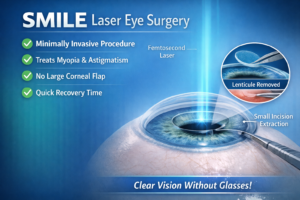
Illustration of SMILE laser eye surgery showing how a femtosecond laser creates and removes a lenticule through a small incision to correct myopia and astigmatism without a large corneal flap.
SMILE Surgery Sydney — Who May Be Suitable?
You may be suitable for SMILE laser eye surgery in Sydney if you:
- Are 18 years or older
- Have stable vision
- May also have astigmatism
- Prefer a flap-free laser vision correction option
- Have suitable corneal thickness and shape – assessed with Corneal topography
Suitability varies between individuals.
A suitability eye examination is required before confirming whether SMILE surgery is appropriate.
What Vision Problems Can SMILE Treat?
SMILE laser eye surgery is commonly used to treat:
- Myopia (short-sightedness)
- Myopia with astigmatism
If you are long-sighted (hyperopic), Dr. Daya Sharma may recommend alternative procedures such as LASIK or PRK.
Benefits of SMILE Laser Eye Surgery
Potential benefits of SMILE vision correction may include:
- Small incision technique
- No large corneal flap
- Reduced risk of flap-related complications
- May support faster comfort recovery compared with some surface procedures
- Suitable for selected patients with active lifestyles
- May reduce dependence on glasses or contact lenses
Outcomes vary between individuals, and no procedure guarantees complete independence from glasses.
SMILE vs LASIK — What Is the Difference?
SMILE
- Small incision (typically 2–4 mm)
- No large corneal flap
- Single laser system
- May preserve more corneal structure
LASIK
- Requires creation of a corneal flap
- Two-step procedure
- Widely performed and well-established
Both procedures can be effective when performed on suitable candidates.
Dr. Sharma will recommend the most appropriate procedure based on your individual eye measurements.
SMILE vs PRK — How Do They Compare?
SMILE
- Small incision technique
- Typically faster comfort recovery
- No surface removal
PRK
- Surface-based procedure
- May be suitable for thinner corneas
- Longer healing period
Each procedure has specific advantages depending on eye structure and lifestyle needs.
What Happens During SMILE Laser Eye Surgery?
Understanding the SMILE surgery process can reduce uncertainty and improve confidence.
Watch this short video where Dr. Sharma explains what will happen during SMILE Laser Eye Surgery.
Before SMILE Surgery
A detailed eye assessment is required to determine suitability.
Testing typically includes:
- Vision testing
- Corneal thickness measurement
- Corneal mapping (topography)
- Tear film and dry eye assessment
- Review of medical and eye history
These measurements help create a personalised treatment plan.
During SMILE Surgery
SMILE laser eye surgery is usually performed as a day procedure.
Typical steps include:
-
-
- Numbing eye drops are applied
- A femtosecond laser creates the lenticule
- A small incision is made
- The lenticule is gently removed
- The cornea reshapes naturally
-
The laser portion usually takes only a few minutes per eye.
After SMILE Surgery
Most patients notice visual improvement within the first few days.
During early healing, you may experience:
- Mild discomfort
- Light sensitivity
- Temporary dryness
- Blurred or fluctuating vision
Follow-up visits are important to monitor healing and visual progress.
SMILE Recovery Timeline — What to Expect
Recovery varies, but many patients:
- Return to routine activities within a few days
- Resume driving once legal vision requirements are met
- Notice gradual visual improvement over several weeks
Eye drops are usually prescribed to support healing.
During early recovery, you may be advised to:
- Avoid rubbing your eyes
- Avoid swimming
- Avoid dusty environments
- Dr. Sharma will provide personalised recovery instructions.
Risks and Possible Complications of SMILE
All surgical procedures carry risks, including SMILE laser eye surgery.
Possible risks may include:
- Dry eye symptoms
- Glare or halos
- Undercorrection or overcorrection
- Infection
- Inflammation
- Visual disturbances
- Need for additional treatment
Most complications occur infrequently, but every surgical procedure carries some level of risk.
A consultation allows discussion of risks specific to your eyes.
Why Dry Eye Assessment Matters Before SMILE
Dry eye disease is common and can affect surgical outcomes.
An unstable tear film may lead to:
- Inaccurate measurements
- Slower healing
- Fluctuating vision
For this reason, Dr. Sharma and his team assesses tear film health before SMILE surgery.
If you have dry eye, Dr. Sharma may recommend treatment before surgery to support accurate measurements and recovery
Why Choose Dr Daya Sharma for SMILE Laser Eye in Surgery?
Dr Daya Sharma is a Sydney ophthalmologist with extensive experience in laser vision correction and a special interest in helping patients achieve their best possible vision. In addition to treating patients seeking freedom from glasses and contact lenses, he works with elite and professional cricketers through his involvement with Cricket NSW and Cricket Australia, with a focus on optimising visual performance beyond standard vision testing.
Dr Sharma uses advanced diagnostic technology to assess not only whether a patient is suitable for SMILE surgery, but also the quality of vision they can expect after treatment. Every assessment and treatment plan is tailored to the patient’s lifestyle, occupation, sporting activities, and visual goals.
Patients benefit from personalised care, modern technology, and extensive experience in refractive surgery, with a strong focus on safety, precision, and long-term visual outcomes.
Read more: Beyond 6/6: Vision Correction Reshaping Sports Performance.
Book a Refractive Surgery Consultation
To find out whether SMILE surgery is right for you, book a comprehensive refractive consultation with Dr Daya Sharma. Your assessment will include a detailed evaluation of your eyes, discussion of your visual goals, and personalised advice regarding the most suitable vision correction options for your individual needs.
Frequently Asked Questions About SMILE Laser Eye Surgery
Is SMILE surgery painful?
Dr. Sharma applies numbing drops to keep your eye comfortable during SMILE surgery. Most patients feel pressure rather than pain during the procedure.
Some mild discomfort may occur after surgery.
How long does SMILE surgery take?
The laser portion typically takes only a few minutes per eye. Total time in the procedure room is usually short.
How quickly does vision improve after SMILE?
Many patients notice visual improvement within the first few days. Vision stabilisation may take several weeks.
Will I still need glasses after SMILE?
Some patients may still require glasses for certain tasks.
Results vary between individuals.
Is SMILE laser eye surgery safe?
SMILE is a well-established laser vision correction procedure used worldwide. However, all surgery carries risks, and careful patient selection is essential.
SMILE Laser Eye Surgery Sydney — Book a Consultation
If you are considering SMILE laser eye surgery in Sydney, the first step is a comprehensive eye assessment.
This includes:
- Detailed measurements
- Suitability testing
- Discussion of risks and benefits
- Review of alternative treatment options
A personalised consultation helps determine whether SMILE laser eye surgery is suitable for your eyes.
Complete our online self-test to learn whether SMILE may be an option for you, or book a consultation to explore the best vision correction treatment for your needs.
- Call – (02) 9387 5300 (Bondi Junction) or (02) 95315300 (Miranda)
- Book Now Through Our Website
Find out if you are suitable for vision correction
Not everyone is eligible for vision correction surgery.
Find out if you could benefit from this life changing surgery by taking the quick self-suitability quiz below: