

Most people assume that if an athlete can read the 6/6 line on an eye chart, their vision is perfect.
However, elite sporting performance often depends on much more than standard visual acuity.
Athletes must rapidly process moving objects, judge speed and distance, track targets under pressure and make split-second decisions in changing visual environments. In many sports, success depends not only on physical ability but also on how efficiently the brain and eyes work together.
At Eye & Laser Surgeons, we are interested not only in helping athletes see clearly but also in understanding and optimising visual performance.
Dr Daya Sharma works with elite athletes through collaborations with Cricket NSW and Cricket Australia and has a particular interest in the relationship between vision and sporting performance.
Whether you are a professional athlete, aspiring junior athlete, weekend competitor or coach, understanding your visual strengths and limitations may help optimise performance and confidence.
BOOK A SPORTS VISION ASSESSMENT
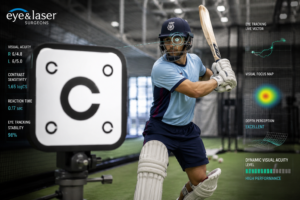
Sports vision assessments evaluate visual skills beyond standard 6/6 vision, including contrast sensitivity, eye tracking, depth perception and kinetic visual acuity.
What Is Sports Vision?
Sports vision refers to the visual skills that contribute to athletic performance.
Many of these skills are not routinely assessed during a standard eye examination.
Sports vision may include:
- Visual acuity
- Dynamic visual acuity
- Kinetic visual acuity
- Contrast sensitivity
- Peripheral awareness
- Depth perception
- Binocular vision
- Visual reaction time
- Glare recovery
- Visual processing speed
While 6/6 vision remains important, many athletes discover that visual performance extends far beyond what can be measured on a standard eye chart.
Why Vision Matters in Sport
Vision provides the majority of sensory information used during sport.
Athletes continuously gather information about:
- Speed
- Distance
- Direction
- Rotation
- Position
- Movement patterns
- Opponent behaviour
This information must be processed rapidly and accurately.
A fraction of a second may determine whether a batter plays the correct shot, a goalkeeper makes a save or a tennis player anticipates the direction of a serve.
Consequently, even small improvements in visual performance may translate into meaningful improvements in sporting performance.
Sports Vision and Cricket
Cricket is one of the most visually demanding sports.
A fast bowler may release the ball at speeds exceeding 140 km/h.
The batter must then:
- Detect the ball immediately after release
- Judge line and length
- Estimate speed
- Assess seam orientation
- Identify swing
- Recognise spin
- Execute a motor response
All of this occurs in less than half a second.
Dr Daya Sharma has a particular interest in cricket vision and works with Cricket NSW and Cricket Australia to better understand visual performance in elite cricketers.
This work includes evaluating how visual performance, kinetic visual acuity, contrast sensitivity and refractive correction may influence athletic performance.
Beyond 6/6 Vision
Many elite athletes achieve visual acuity significantly better than 6/6. 6/6 is often regarded as normal visual acuity, and is the visual acuity standard required for commercial pilots. A significant number of professional cricketers can see 6/3 or better, which means that they can make out the same detail that a pilot can see, but from twice as far away.
However, excellent sporting vision requires more than simply seeing a static chart.
Several visual skills may influence athletic performance.
Dynamic Visual Acuity
Dynamic visual acuity refers to the ability to identify details in moving objects.
This skill may be particularly important in sports involving:
- Cricket
- Tennis
- Baseball
- Hockey
- Motorsport
Kinetic Visual Acuity
Kinetic visual acuity refers to the ability to recognise a target moving towards the observer.
This may be particularly important when tracking:
- Cricket balls
- Tennis balls
- Baseballs
- Hockey pucks
Eye & Laser Surgeons is actively involved in developing and evaluating advanced methods of assessing kinetic visual acuity and visual performance in athletes.
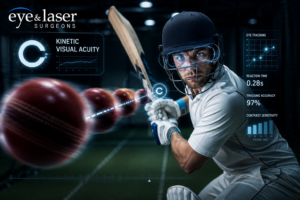
Cricket places extraordinary demands on kinetic visual acuity, requiring athletes to recognise and respond to rapidly moving objects.
Contrast Sensitivity
Not all sporting environments provide ideal visual conditions.
Athletes often compete under:
- Floodlights
- Cloud cover
- Glare
- Shadows
- Variable backgrounds
Contrast sensitivity measures the ability to detect subtle differences between an object and its background.
Athletes with excellent contrast sensitivity may perform better in visually challenging environments.
Depth Perception
Depth perception helps athletes judge distance and spatial relationships.
It may influence:
- Catching
- Fielding
- Batting
- Goalkeeping
- Racquet sports
Depth perception depends on healthy binocular vision and accurate eye alignment.
Eye Tracking
Eye tracking refers to the ability to follow moving targets smoothly and accurately.
Efficient eye tracking may be important in:
- Cricket
- Tennis
- Baseball
- Hockey
- Motorsport
Visual Reaction Time
Visual reaction time measures how quickly an athlete responds to visual information.
This may be particularly relevant in sports that require rapid decision-making under pressure.
Comprehensive Sports Vision Assessment
A sports vision assessment involves much more than reading letters on a chart.
Depending on the athlete and sport involved, assessment may include:
Visual Acuity Testing
Measurement of standard and high-performance visual acuity.
Refraction
Assessment of:
- Myopia
- Hyperopia
- Astigmatism
Even small refractive errors may influence performance in some athletes.
Corneal Topography and Tomography
Advanced corneal imaging helps assess:
- Corneal shape
- Astigmatism
- Irregular astigmatism
- Early keratoconus
Ocular Wavefront Analysis
Wavefront analysis measures subtle optical imperfections that may affect visual quality.
This information may be useful when considering laser vision correction.
Binocular Vision Assessment
Assessment of:
- Eye alignment
- Fusion
- Depth perception
- Ocular dominance
Contrast Sensitivity Testing
Assessment of visual performance under more challenging conditions than standard visual acuity testing.
Eye Health Examination
Comprehensive assessment of retinal, optic nerve and ocular health.
Vision Screening for Professional Athletes
Elite athletes often undergo detailed physical and physiological testing.
Vision is increasingly being recognised as another important component of performance assessment.
Vision screening may help identify:
- Undiagnosed refractive errors
- Binocular vision issues
- Reduced contrast sensitivity
- Eye health concerns
- Visual performance limitations
Athletes frequently spend years refining strength, conditioning and technique. However, many havenever undergone a detailed sports vision assessment.
Laser Vision Correction for Athletes
Many athletes choose laser vision correction to reduce dependence on glasses and contact lenses.
Potential benefits may include:
- Greater convenience
- Freedom from contact lenses
- Reduced fogging
- Reduced risk of lens displacement
- Simplified training and competition preparation
Treatment options may include:
The most appropriate treatment depends on the individual’s eyes, visual requirements and sporting activities.
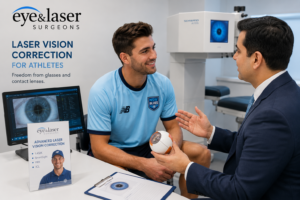
Many athletes choose laser vision correction to reduce dependence on glasses and contact lenses during training and competition.
Which Athletes Consider Laser Vision Correction?
Athletes from a wide variety of sports consider laser vision correction.
Examples include:
- Cricketers
- Tennis players
- Golfers
- Cyclists
- Triathletes
- Swimmers
- Martial artistsOther professions:
- Defence personnel
- Pilots
- Emergency services personnel
Many athletes value the freedom and convenience that laser vision correction may provide.
Why Athletes Choose Dr Daya Sharma
Dr Daya Sharma is a corneal, cataract and refractive surgeon with a particular interest in visual performance.
His expertise includes:
- LASIK
- SMILE
- PRK
- Wavefront-guided treatments
- Implantable Collamer Lenses
- Keratoconus management
- Irregular astigmatism
- Premium cataract surgery
Dr Sharma collaborates with Cricket NSW and Cricket Australia and has a strong interest in understanding how visual performance influences athletic performance.
His approach extends beyond helping patients achieve 6/6 vision and focuses on maximising quality of vision, visual performance and freedom from visual limitations.
Read:
Beyond 6/6 Vision: How Vision Correction Is Reshaping Sports Performance
Frequently Asked Questions About Sports Vision
What is sports vision?
Sports vision refers to the visual skills that contribute to athletic performance, including visual acuity, contrast sensitivity, depth perception, eye tracking and visual reaction time.
Is 6/6 vision enough for elite sport?
Not necessarily.
Many elite athletes have vision better than 6/6. In addition, sporting performance depends on many visual skills that are not measured on a standard eye chart.
What is kinetic visual acuity?
Kinetic visual acuity is the ability to identify and recognise objects moving towards the observer.
This may be particularly important in sports such as cricket, tennis and baseball.
Can vision affect sporting performance?
Yes.
Vision plays a critical role in recognising, tracking and responding to moving targets.
Even subtle visual limitations may influence performance.
Can laser eye surgery improve sporting performance?
Laser vision correction does not automatically improve sporting ability.
However, many athletes appreciate the convenience and freedom from glasses or contact lenses during training and competition.
Do professional athletes have better eyesight than average people?
Some do, while others require glasses, contact lenses or refractive surgery.
Elite performance depends on a combination of visual, physical and psychological factors.
What sports benefit most from sports vision assessment?
Sports involving fast-moving objects often place particularly high demands on the visual system, including cricket, tennis, baseball, hockey and motorsport.
Can children have sports vision testing?
Yes.
Sports vision assessments may help identify visual issues that could affect both sporting performance and academic activities.