
If your child’s glasses prescription is becoming stronger, our first question is not:
“Which treatment should we use?”
We need to answer two questions first:
Is the myopia actually getting worse?
and, if it is:
Does that progression matter?
For some children, a small change in prescription may not represent significant ongoing eye growth. For others, increasing myopia reflects continuing axial elongation — the eye itself is becoming longer.
That distinction matters because our goal in myopia management is not simply to stop a child needing stronger glasses.
Our goal is to reduce the ocular complications of excessive elongation of the eye and, in doing so, reduce the cumulative stretching of the tissues of the retina, choroid and sclera at the back of the eye over a lifetime.
This is why we measure more than the glasses prescription.
At Eye & Laser Surgeons, Dr Shanel Sharma will consider the child’s age, cycloplegic refraction, axial length, rate of change, corneal shape, family history and other risk factors before deciding whether treatment is necessary.
You can read more about this process in our guide to childhood myopia assessment.
Why does worsening myopia matter?
Glasses can usually make a myopic child see clearly.
So parents reasonably ask:
If glasses correct the vision, why do we need to slow the myopia?
The concern is not simply the number written on the glasses prescription.
It is what may be happening to the eye underneath that prescription.
In most progressive childhood myopia, the eye becomes progressively longer. As the eye elongates, the retina, choroid and supporting tissues at the back of the eye must cover a larger area.
Think of a pizza base
A simple way to picture this is to imagine a ball of pizza dough.
When the dough is small, it is relatively thick.
As you stretch the same amount of dough into a larger and larger pizza base, it becomes progressively thinner.
The eye is obviously much more complex than pizza dough. However, the analogy helps explain what concerns us about excessive axial elongation.
As a myopic eye becomes longer, the tissues lining the back of the eye undergo increasing stretch.
We are therefore not treating a child simply because we dislike a −2.00 D or −4.00 D prescription.
We are trying to limit excessive eye growth and reduce the lifetime consequences associated with increasing axial myopia.
Higher levels of myopia carry increasing risks of conditions such as myopic macular degeneration and retinal detachment later in life.
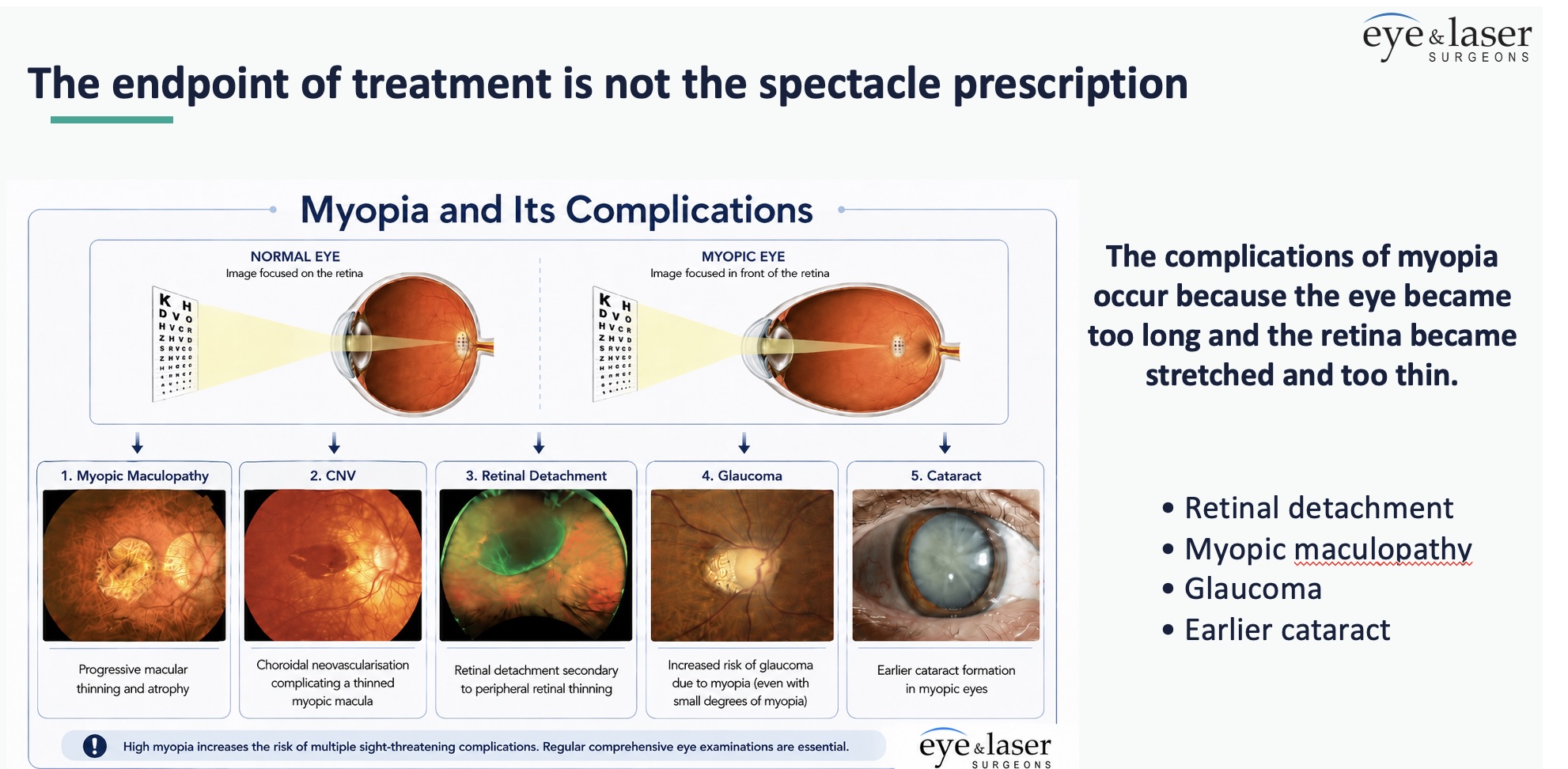
The aim of childhood myopia control is not simply to limit changes in the glasses prescription. Excessive axial elongation stretches the tissues at the back of the eye and is associated with increased lifetime risks of myopic maculopathy, retinal detachment, glaucoma and earlier cataract.
So the long-term question becomes:
Can we slow the stretching now to reduce risk later?
That is the purpose of myopia control.
First question: is the myopia actually progressing?
A stronger glasses prescription does not automatically prove that the eye has become significantly longer.
We therefore look at change over time.
Two measurements are particularly useful.
Cycloplegic refraction tells us how the eye focuses when we temporarily relax accommodation.
Axial length tells us how long the eye is.
When the prescription becomes more myopic and the axial length increases in a corresponding way, progressive axial myopia becomes much more likely.
However, sometimes the measurements do not tell the same story.
That is when we need to ask another question.
Is it axial myopia — or is something else changing?
This is an important part of myopia assessment that can easily be overlooked.
Imagine that a child’s prescription becomes increasingly myopic, but their axial length has changed very little.
Why?
The refractive change may not be coming primarily from axial elongation.
One possibility is a change in the cornea.
If the cornea becomes progressively steeper or increasingly irregular, it can produce increasing myopia and astigmatism.
In a child or teenager, we therefore need to consider conditions such as keratoconus, particularly when we see increasing astigmatism, asymmetry between the eyes, reduced best-corrected vision or other suspicious findings.
Keratoconus requires a completely different management strategy from axial myopia.
That is why we believe:
Before treating progression, first understand what is progressing.
Where appropriate, assessment may include corneal topography or tomography as well as refraction and axial-length measurement.
If the myopia is progressing, do we need to treat it?
Not every child with myopia automatically needs the same treatment.
We consider several factors together.
A seven-year-old whose eye is elongating rapidly has a very different lifetime risk from a 16-year-old whose prescription has barely changed.
Likewise, a child with strong family history, early-onset myopia or rapid axial growth may warrant more active management.
For some children, observation and careful monitoring may remain appropriate.
For others, we may recommend active myopia control.
The aim is not to treat simply because treatment exists.
The aim is to intervene when the potential long-term benefit justifies the burden and risks of treatment.
What are the treatment options for progressive childhood myopia?

Regular outdoor time is an important part of childhood myopia prevention and management. For children using atropine who experience light sensitivity, sunglasses and a hat may help them remain comfortable outdoors.
The first line treatment is high lux light – achieved with outdoor time
Outdoor time remains an important part of childhood myopia management.
Research consistently shows that children who spend more time outdoors have a lower risk of developing myopia. In children who are already myopic, some studies also suggest that greater outdoor exposure may modestly reduce myopia progression and axial elongation, although this effect is less consistent than its effect on preventing myopia from developing in the first place.
For this reason, we encourage regular outdoor activity as part of a child’s overall myopia-management plan.
However, outdoor time does not replace treatment when a child’s myopia is progressing significantly. A child with continuing axial elongation may still need atropine, myopia-control spectacle lenses, contact lenses or combination treatment where appropriate.
We also need to balance the benefits of outdoor light with sensible protection from excessive ultraviolet exposure. More time outdoors does not mean children should spend prolonged periods in intense sunlight without appropriate sun protection.
The important principle is:
Outdoor time is part of myopia management, not an alternative to understanding and monitoring the child’s eye growth.
Modern myopia management gives us several choices.
The main options include low-dose atropine, myopia-control spectacle lenses, myopia-control contact lenses and, more recently, repeated low-level red-light therapy.
No single option automatically suits every child.
Atropine eye drops: 0.01%, 0.025% and 0.05%
Low-dose atropine can reduce myopia progression and axial elongation.
In Australia, clinicians can now have pre-manufactured Atropine in all 3 concentrations.
Although greater myopia control is usually achieved with higher concentrations, the problem is that after the treatment is stopped the deterioration is worse with higher concentrations. Furthermore, higher concentrations also produced greater effects on pupil size and near focusing. So we aim to give the lowest dose to achieve the best outcome with the least side effects and minimise long term rebound.
That means we need to balance:
How much additional control are we trying to achieve?
against:
What additional treatment burden or side effects might that concentration create?
For example, some children experience light sensitivity, glare or near-vision difficulty.
The answer is therefore not simply to prescribe the highest concentration.
Nor should we assume that the lowest concentration will provide sufficient control for every child.
We choose a concentration, measure the response and change the strategy when necessary.
What about atropine 0.025%?
The original LAMP trial did include 0.025% atropine and found treatment effects between those of 0.01% and 0.05% for several measured outcomes.
However, fewer independent studies have focused specifically on 0.025% than on some other atropine regimens.
Therefore, we should avoid assuming that every efficacy result, side effect and rebound characteristic will always sit neatly halfway between 0.01% and 0.05%.
We use the available evidence, but we also monitor the individual child.
Myopia-control spectacle lenses
Spectacle-based myopia control has developed rapidly.
These lenses do more than correct distance blur. They use specialised optical zones to create retinal signals designed to reduce axial length growth.
First-generation myopia-control lenses
The first major generation included technologies such as DIMS and highly aspherical lenslet designs.
Clinical trials demonstrated that these lenses could reduce both refractive progression and axial elongation compared with conventional single-vision glasses.
This represented an important shift in paediatric eye care.
The child’s glasses could now perform two jobs:
- correct vision
2. help control eye growth.
Second-generation myopia-control lenses
Newer second-generation designs aim to strengthen or optimise the myopic-defocus signal.
For example, newer DIMS designs increase the magnitude and extent of the treatment zones, while newer highly aspherical lenslet designs aim to increase the volume or strength of the myopic-defocus signal.
Early results are encouraging.
However, we should distinguish newer technology from long-term proven superiority.
Some second-generation platforms do not yet have the same depth of long-term clinical evidence as their predecessors.
We therefore need to consider what we know, what remains under investigation and whether the newer design offers a meaningful reason to change treatment for that particular child.
You can read more about these developments in our guide to new myopia treatments.
Myopia-control contact lenses
Contact lenses can also slow myopia progression in selected children.
Options include specialised soft dual-focus or multifocal myopia-control contact lenses and orthokeratology.
These treatments alter the optical signals reaching the peripheral retina.
They can provide effective myopia control in suitable patients.
However, contact lenses introduce different considerations from spectacles.
The child and family need to manage lens handling, cleaning, hygiene and appropriate follow-up.
Therefore, efficacy is not our only consideration.
A treatment only works well in practice if the child can use it safely and consistently.
For some children, contact lenses provide an excellent option.
For others, spectacles or atropine may offer a lower-burden approach.
What about red-light therapy for myopia?
Repeated low-level red-light therapy, often called RLRL, has attracted considerable interest.
Several clinical trials and recent meta-analyses have reported substantial short-term reductions in axial elongation.
Those results deserve attention.
However, efficacy is only part of the decision.
We also need to understand long-term safety.
Recent literature has described temporary retinal structural changes in some patients, and researchers continue to investigate the significance of these findings. Questions also remain about device dosimetry, long-term exposure and rebound after treatment stops.
For that reason, we approach red-light therapy cautiously.
A strong short-term efficacy signal does not automatically establish long-term safety.
This is particularly important when we treat otherwise healthy children over several years.
Our preference is to understand both the potential benefit and the uncertainties before recommending a newer treatment.
Which treatments do we prefer?
We do not start with the question:
“Which treatment is strongest?”
We start with:
“What does this child need?”
Where several options may provide reasonable control, we generally favour treatments that combine good evidence, acceptable risk, practical day-to-day use and a high likelihood that the child will continue them.
For one child, that may mean a myopia-control spectacle lens.
For another, low-dose atropine may make sense.
A different child may benefit from contact lenses.
And some children need more than one strategy.
We remain more cautious with treatments where long-term safety or durability remains less certain.
The treatment hierarchy can therefore change as new evidence develops.
Why side effects matter
The most effective treatment on paper is not necessarily the most appropriate treatment in real life.
A child has to read.
They have to learn.
They have to use screens.
They need to play sport.
And importantly, they should continue spending time outdoors.
If atropine produces significant photophobia or near blur, that matters.
If a contact lens creates unacceptable handling or infection risk, that matters.
If a spectacle design reduces visual comfort enough that the child refuses to wear it, that matters.
Treatment decisions therefore involve more than comparing percentages from clinical trials.
We need efficacy that the child can actually live with.
Why rebound matters
We also need to think about what happens when treatment stops.
Myopia management does not necessarily switch off the biological tendency for the eye to grow.
If treatment stops while that growth remains active, myopia can begin progressing more quickly again.
We call this rebound.
Atropine provides the best-known example, although rebound or renewed progression can also become relevant when other treatments stop.
Repeated low-level red-light therapy has also raised questions about rebound after cessation.
This is why we treat stopping as part of the treatment plan.
We consider:
the child’s age
their recent axial growth
how long they have remained stable
the treatment they are using
and what happened during previous dose reductions or treatment changes.
Our guide to myopia rebound explains this in more detail.
When do we use combination treatment?
Sometimes one treatment does not provide enough control.
A child may continue to show significant axial elongation despite good adherence.
In selected children, we may therefore combine treatments.
For example, a child may use atropine together with a myopia-control spectacle lens.
Other combinations may include atropine with an appropriate contact-lens strategy.
Research increasingly supports combination treatment in selected higher-risk or faster-progressing children.
However, more treatment is not automatically better.
Every additional treatment adds cost, complexity and potential side effects.
Combination therapy is typically an off label use for these treatments.
We therefore ask:
What additional benefit are we likely to gain by adding another treatment?
If the expected benefit justifies the additional burden, combination therapy may make sense.
If it does not, continuing a simpler strategy may be better.
Our approach: understand first, then treat
At Eye & Laser Surgeons, Dr Shanel Sharma believes the sequence matters.
We first establish whether the myopia is progressing.
Then we ask whether that progression represents meaningful axial elongation.
If the measurements do not fit together, we look for another explanation — including changes in corneal shape such as keratoconus.
If active treatment is appropriate, we discuss the available options.
We consider atropine, myopia-control spectacles, contact lenses and emerging treatments according to the individual child.
Then we monitor.
If treatment works and the child tolerates it, we may continue.
If the eye keeps growing, we reconsider the strategy.
If side effects outweigh the benefit, we change it.
And when the time comes to reduce or stop treatment, we continue monitoring for rebound.
Myopia management is not about choosing a product.
It is about understanding a child’s eye growth over time and making the best decision at each stage of that journey.
What about refractive surgery for myopia later in life?
When a child reaches adulthood and their prescription has stabilised, laser eye surgery and other forms of vision correction may be appropriate for some people who want to reduce their dependence on glasses or contact lenses.
Procedures such as LASIK, SMILE and PRK can correct the refractive error caused by myopia by changing how light focuses within the eye.
However, refractive surgery does not shorten an eye that has already become elongated.
This distinction matters.
If significant axial myopia has stretched the retina and other tissues at the back of the eye during childhood and adolescence, correcting the glasses prescription later does not reverse those structural changes. The longer-term risks associated with axial myopia — including retinal tears and detachment, myopic macular degeneration and other myopia-related eye disease — therefore remain.
In other words:
Refractive surgery may correct the blur caused by myopia. Myopia control aims to reduce how much the eye stretches in the first place.
That is why our goal during childhood is not simply to make the prescription easier to correct later. Where appropriate, we aim to limit excessive axial elongation while the eye is still growing.
Adults with myopia who are considering Laser vision correction can learn more about myopia and vision correction and the different laser eye surgery options. Suitability depends on a comprehensive assessment of the individual eye.