

LASIK vs SMILE vs PRK:
Which Procedure May Be Right For You?
There is no single “best” Laser eye surgery procedure. LASIK, SMILE and PRK each have advantages and limitations and different areas where they may be most appropriate. The right choice depends on your eyes, your prescription, your lifestyle and your long-term visual goals following a comprehensive assessment.
LASIK, SMILE and PRK are all effective laser vision correction procedures. They differ in how they reshape the cornea, recovery time, suitability and potential advantages for different patients. No procedure is best for everyone. The most appropriate option depends on careful assessment of your eyes and visual goals.
Choosing the right procedure depends on several important factors. These include your prescription, corneal thickness and shape, tear film quality, and your lifestyle or visual demands.
In many cases, the goal is not simply achieving 6/6 vision on a chart. Instead, it is about achieving stable, consistent and high-quality vision in real-world environments.
This is particularly relevant for athletes, surgeons, tradies, emergency workers, and other professionals who rely on precise visual performance.

Comparing LASIK, SMILE & PRK
SMILE, LASIK and PRK are different laser vision correction techniques and the most suitable option depends on your eye structure, prescription and lifestyle.
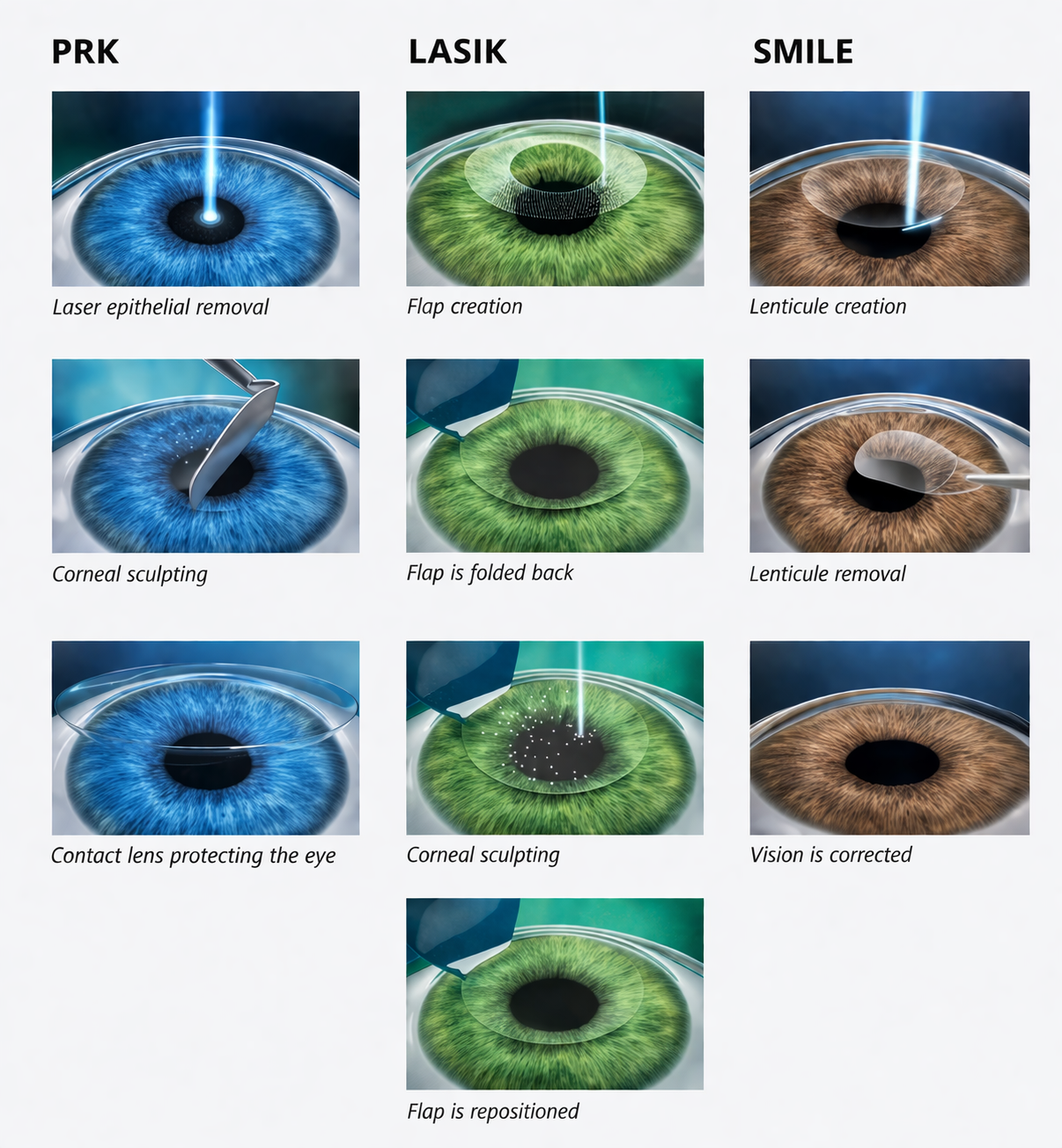
| Feature | SMILE | LASIK | PRK |
|---|---|---|---|
| Flap | No | Yes | No |
| Dry eye risk | Lower | Moderate | Moderate |
| Recovery | Moderate | Fast | Slower |
| Best for | Active lifestyles | Most patients | Thin corneas |
Why Choose Dr Daya Sharma For Laser Eye Surgery?
Dr Daya Sharma is a corneal, cataract and refractive surgeon with fellowship training from Moorfields Eye Hospital in London.
His approach focuses on detailed, individualised assessment. Rather than using a one-size-fits-all model, the aim is to select the most appropriate procedure for each patient.
In addition, there is a strong emphasis on visual quality, not just visual acuity. This is particularly important for patients with demanding visual requirements.
Vision Screening in Elite Cricket
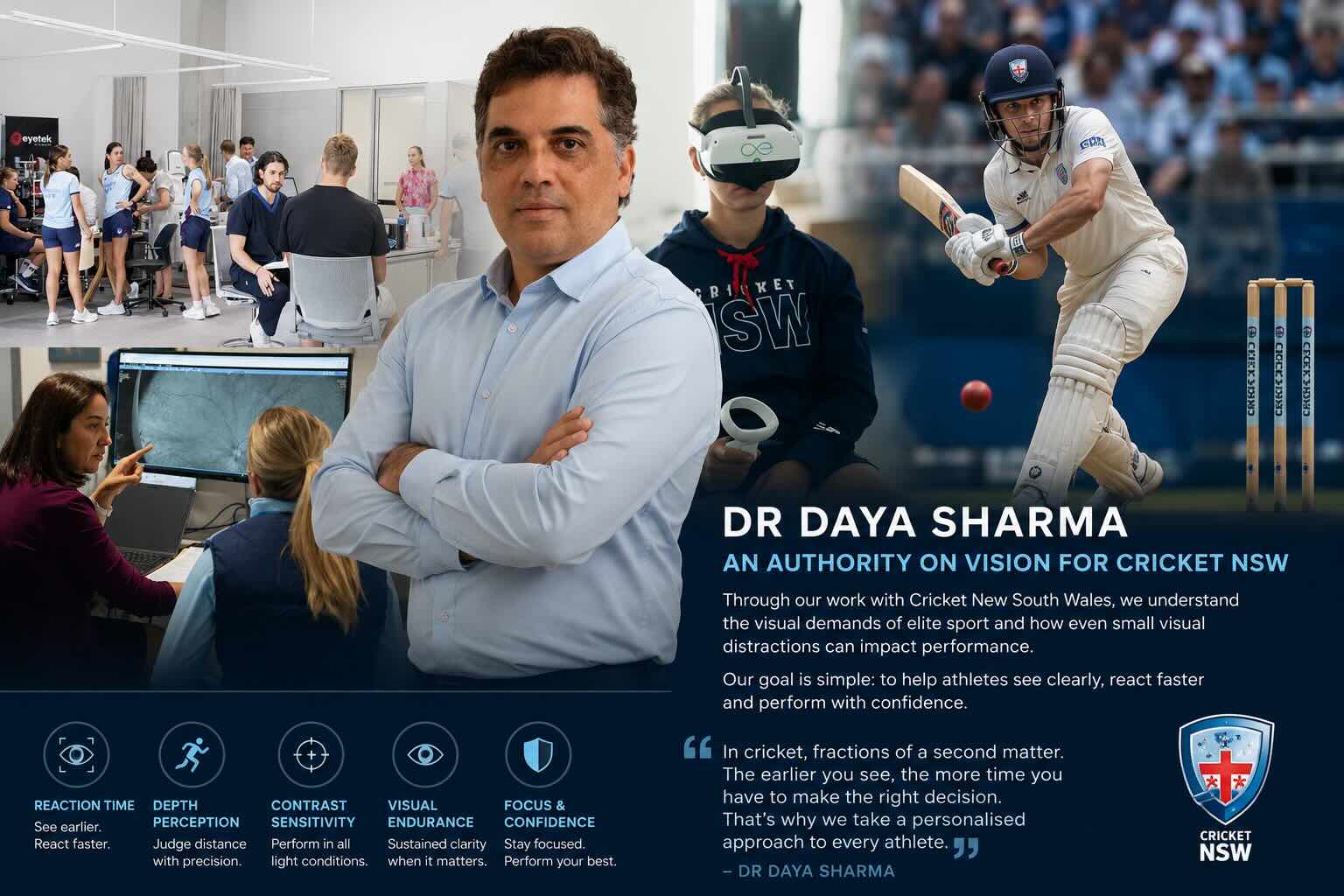
Dr Daya Sharma has been involved in vision screening for professional cricketers through work with Cricket NSW and Cricket Australia, assessing visual function in high-speed sporting environments.
Dr Daya Sharma and Dr Shanel Sharma have also contributed academically, co-authoring a chapter in Cricket Sports Medicine.
This work examines how the visual system functions beyond standard clinical testing, providing additional context when assessing patients for laser vision correction.
Read more: https://mivision.com.au/2025/07/optimising-vision-for-cricketers-performance/
Who Is Suitable For Laser Eye Surgery?
You may be suitable if you:
- have stable vision
- are short-sighted, long-sighted or have astigmatism
- are seeking reduced dependence on glasses or contact lenses
Who May Not Be Suitable?
Laser eye surgery may not be appropriate if you have:
- keratoconus or irregular corneal shape
- unstable prescription
A detailed suitability assessment is required to determine suitability.
Risks of Laser Eye Surgery
All surgical procedures carry some risk. These may include:
- infection (rare)
- dry eye symptoms
- visual disturbances such as glare or halos
These risks are carefully discussed during consultation.
Recovery After Laser Eye Surgery
Recovery varies depending on the procedure:
- LASIK → rapid visual recovery (often within 24–48 hours)
- SMILE → slightly slower initial recovery
- PRK → longer recovery period over several days to weeks
Cost of Laser Eye Surgery in Sydney
The cost of laser eye surgery varies depending on the procedure and individual factors.
A consultation is required to determine suitability and provide an accurate treatment plan.
Life after laser vision correction. Many patients find they can enjoy everyday moments—like travel and time with loved ones—without relying on glasses or contact lenses.
Frequently Asked Questions
Which laser eye surgery procedure is best?
There is no single “best” laser eye surgery procedure. LASIK, SMILE and PRK each have advantages and limitations, and the most appropriate option depends on your eyes, prescription, corneal measurements, lifestyle and visual goals. Following a comprehensive assessment, we discuss which options may be suitable and explain the reasons behind our recommendations.
Is SMILE better than LASIK?
SMILE and LASIK are both well-established forms of laser vision correction. SMILE uses a small incision to remove a tiny piece of corneal tissue, while LASIK creates a thin corneal flap before reshaping the cornea with an excimer laser.
For some patients, SMILE may offer advantages such as preserving more of the corneal surface. For others, LASIK may provide greater flexibility for certain prescriptions or treatment planning. The most appropriate procedure depends on your individual eyes rather than the technology alone.
Why would someone choose PRK instead of LASIK or SMILE?
Although PRK generally involves a longer recovery, it remains an excellent option for many patients.
Because PRK does not require a corneal flap, it may be considered where flap creation is less desirable, including some patients with thinner corneas or particular occupational or sporting requirements. Recovery usually takes longer than LASIK or SMILE, but the long-term visual outcomes may be comparable for appropriately selected patients.
Which procedure has the fastest recovery?
Many patients notice improved vision within one or two days after LASIK or SMILE, although vision continues to stabilise over time.
PRK typically requires a longer healing period because the surface layer of the cornea needs time to regenerate. Recovery varies between individuals, and we discuss realistic expectations before surgery.
Which procedure causes the least discomfort?
All three procedures are performed using anaesthetic eye drops, so significant discomfort during treatment is uncommon.
Following surgery, recovery experiences differ. Many patients describe LASIK and SMILE as involving relatively mild discomfort, while PRK generally causes more discomfort during the first few days as the surface of the cornea heals. We provide appropriate pain relief and detailed postoperative care instructions.
Can I have laser eye surgery if I have thin corneas?
Not necessarily. Thin corneas do not automatically prevent laser vision correction, but they do require careful assessment.
Corneal thickness is only one factor. We also evaluate corneal shape, stability, prescription and overall eye health. Depending on the findings, LASIK, SMILE, PRK or an alternative procedure such as an Implantable Collamer Lens (ICL) may be more appropriate.
Which procedure is better for contact sports?
Because SMILE and PRK do not involve a permanent corneal flap, they may be considered for patients participating in contact sports or occupations where eye trauma is more likely.
However, this does not mean they are automatically the preferred option. The recommendation always depends on the overall assessment of your eyes and lifestyle.
Will I still need glasses after laser eye surgery?
Laser eye surgery aims to reduce dependence on glasses or contact lenses, but it cannot prevent the normal ageing changes that occur in the eye.
Many people eventually develop presbyopia, the age-related need for reading glasses, and cataracts may also develop later in life. During your consultation, we discuss both your short-term visual goals and your longer-term expectations.
Can laser eye surgery treat astigmatism?
Yes. LASIK, SMILE and PRK may all be used to treat many forms of astigmatism, depending on the degree and pattern of the refractive error.
Detailed corneal mapping helps determine whether the astigmatism is suitable for laser treatment and whether another option would be more appropriate.
How long do the results last?
The changes made to the cornea are intended to be permanent.
However, your eyes continue to change naturally throughout life. Some patients experience small prescription changes over time, while others later develop age-related conditions such as presbyopia or cataracts that affect vision independently of the laser treatment.
How do you decide which procedure to recommend?
Our recommendation is based on much more than your glasses prescription.
We consider:
- your refractive error
- corneal thickness and shape
- corneal stability
- dry eye
- pupil size
- occupation
- sporting activities
- age
- previous eye surgery
- overall eye health
- your visual priorities and expectations
Our goal is not simply to recommend a procedure, but to help you understand which options may be most appropriate and why.
What if none of the procedures is suitable?
Not everyone is an appropriate candidate for LASIK, SMILE or PRK.
Depending on your eyes, we may recommend continuing with glasses or contact lenses, monitoring your vision, or discussing alternative procedures such as Implantable Collamer Lens (ICL) surgery or Refractive Lens Exchange.
Sometimes the most appropriate recommendation is not to proceed with laser surgery, and understanding this is an important part of making an informed decision.
Choosing between LASIK, SMILE and PRK begins with understanding your eyes
Choosing the most appropriate laser eye surgery procedure is rarely about selecting the newest technology or the procedure with the fastest recovery. It is about understanding your individual eyes, your vision, your lifestyle and your long-term goals.
LASIK, SMILE and PRK each have advantages, limitations and situations where they may be more appropriate. Following a comprehensive assessment, we explain the findings, discuss the potential benefits and risks of each suitable option, and answer any questions you may have. Our role is to help you make an informed decision based on clear information rather than assumptions.
For some patients, laser vision correction provides an excellent opportunity to reduce dependence on glasses or contact lenses. For others, another treatment—or even delaying surgery—may be the better choice. We believe every patient deserves to understand all appropriate options before deciding what is right for them.
If you are considering laser vision correction, the first step is a comprehensive assessment. By understanding your eyes first, we can help determine which options may be suitable and guide you through the decision-making process with confidence.
Ready to learn which option may be right for you?
Every patient’s eyes are different. A comprehensive assessment allows us to evaluate your vision, discuss whether LASIK, SMILE or PRK may be appropriate, and explain the benefits, limitations, risks and alternatives before you make a decision.