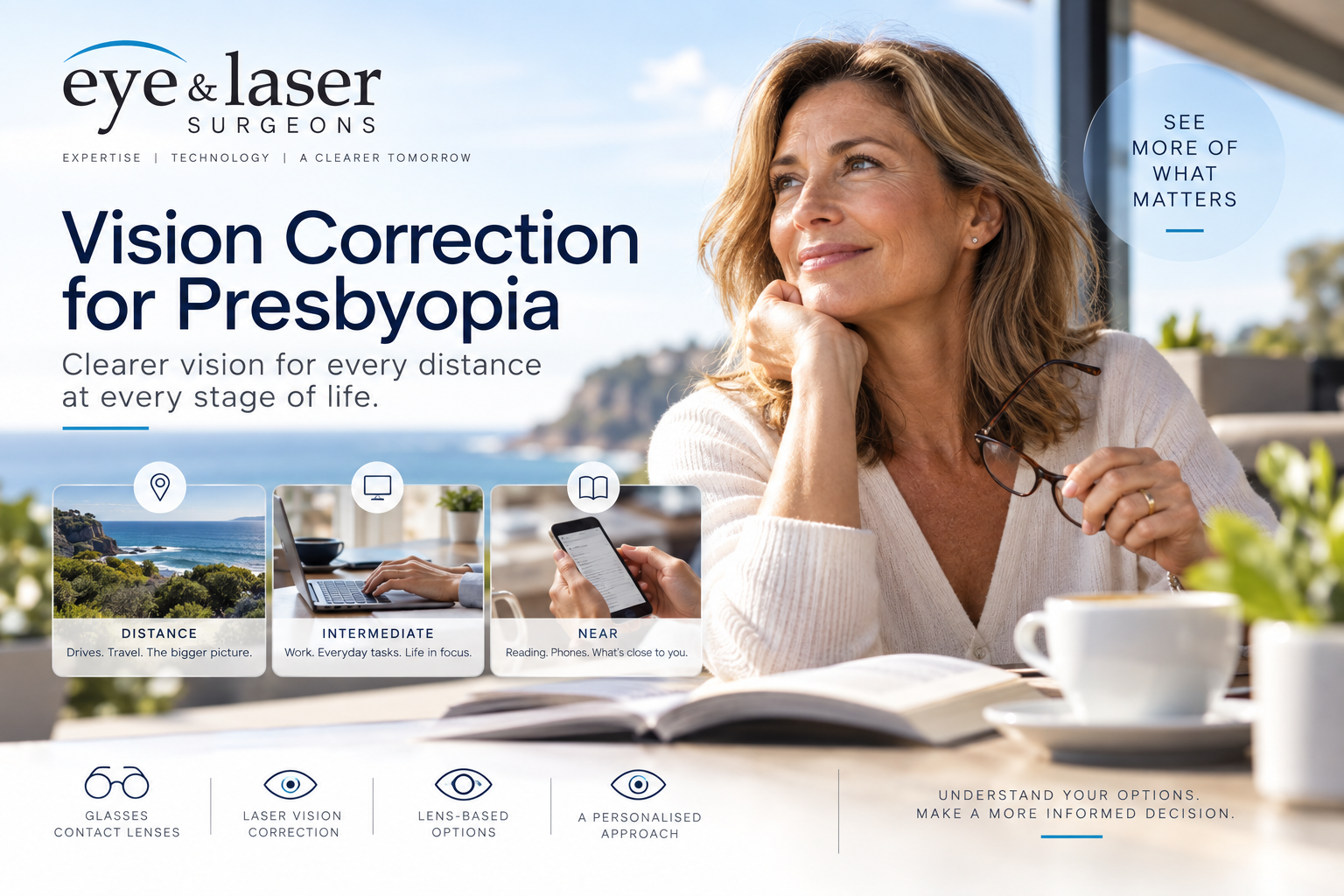
Presbyopia changes the way our eyes focus at near distances. Personalised vision correction may involve glasses, contact lenses, laser strategies or lens-based options depending on the individual.
Vision Correction for Presbyopia
Understanding Your Changing Vision After 40
Perhaps your distance vision is still excellent.
However, your phone suddenly seems easier to read when you hold it further away.
Restaurant menus need brighter light. Small print becomes more difficult. Meanwhile, reading glasses seem to appear in every room, handbag, desk drawer or car.
These changes commonly occur because of presbyopia.
Presbyopia is the age-related reduction in the eye’s ability to focus clearly on nearby objects. Although it often becomes noticeable during the forties, the underlying focusing ability of the eye has been gradually changing for many years.
At Eye & Laser Surgeons, we believe understanding this distinction matters.
Presbyopia is not simply another glasses prescription.
Instead, it reflects an age-related change in the focusing system inside the eye. Therefore, choosing vision correction for presbyopia requires us to think differently from treating straightforward myopia, hyperopia or astigmatism.
Our goal is not simply to remove reading glasses.
Rather, we want to understand how you need to see across distance, intermediate and near—and how those visual needs may change throughout the years ahead.Understand vision correction for presbyopia, including glasses, blended vision, laser and lens options. Learn how age, eye health and lifestyle guide treatment.
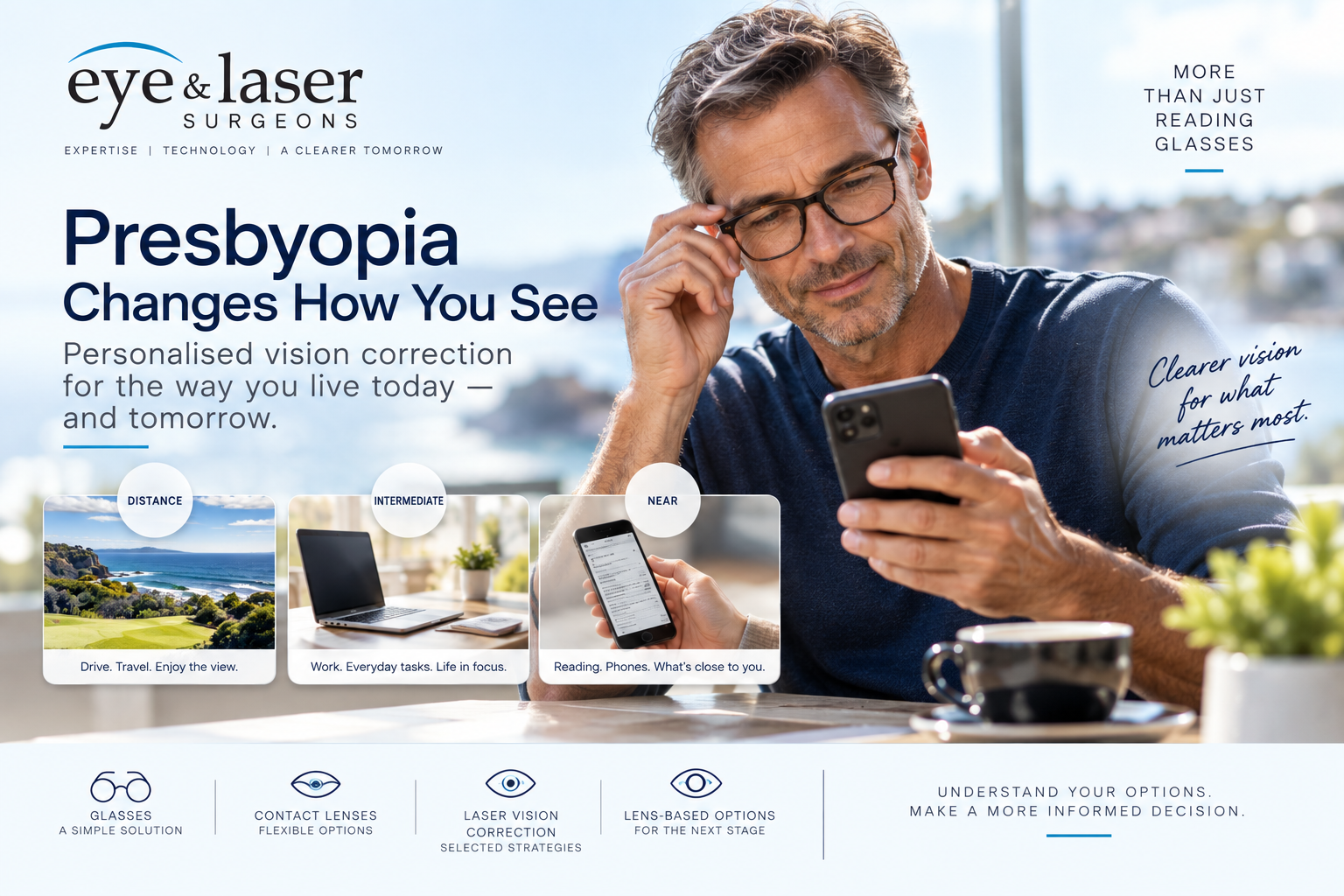
Presbyopia changes how we focus at near and intermediate distances. The most appropriate vision correction strategy depends on your eyes, age, lifestyle and the range of vision that matters to you.
Vision Correction for Presbyopia: In Brief
Presbyopia is the age-related loss of the eye’s ability to focus on nearby objects.
As focusing ability declines, everyday tasks such as reading a phone, menu, book or medication label may become more difficult.
However, there is no single treatment that is right for everyone.
Depending on your eyes, age, occupation, lifestyle and visual goals, options may include:
- reading glasses
- progressive or multifocal glasses
- contact lenses
- monovision or blended vision
- laser vision correction for selected patients
- PresbyLASIK or extended-depth-of-focus strategies where appropriate
- lens-based vision correction
- cataract surgery where cataract is present
Therefore, the most appropriate treatment begins with understanding your eyes and your visual priorities—not choosing a procedure.
What Is Presbyopia?
Presbyopia is a normal age-related change in focusing ability.
When we are younger, our eyes can rapidly change focus between objects at different distances.
This ability is called accommodation.
For example, you might look from:
the road ahead → your dashboard → your phone
without consciously thinking about focusing.
Likewise, you might move from:
a computer screen → a document → someone across the room
and the eyes adjust automatically.
However, accommodation gradually declines throughout life.
Eventually, the eye can no longer generate enough focusing power to maintain comfortable near vision.
As a result, close objects become blurred unless they are moved further away or additional optical power is provided.
How Does the Eye Focus?
Understanding accommodation makes presbyopia much easier to understand.
Inside the eye sits the natural crystalline lens.
When we look at objects at different distances, the eye’s focusing system changes the optical power required to bring the image into focus on the retina.
When we are young, this system provides a substantial range of accommodation.
However, that range progressively decreases with age.
Eventually, there is not enough accommodation available to comfortably focus at normal reading distance.
That is when many people first become aware of presbyopia.
People often say:
“My eyes were fine until I turned 40.”
However, presbyopia does not suddenly switch on at a particular birthday.
Instead, accommodative ability declines gradually throughout life.
For many years, there is still enough focusing reserve to perform near tasks comfortably. Eventually, however, the remaining accommodation becomes insufficient for the person’s usual reading distance.
That is when symptoms become noticeable.
Therefore, two people of the same age may experience presbyopia differently.
One person may begin using reading glasses relatively early. Meanwhile, another may continue reading comfortably for longer.
Their underlying refractive error, working distance and visual demands can all influence when symptoms become apparent.
What Are the First Signs of Presbyopia?
Presbyopia often develops gradually.
Initially, you may notice:
- holding your phone further away
- needing brighter light to read
- increasing the font size on digital devices
- difficulty reading restaurant menus
- eye fatigue during prolonged close work
- difficulty changing focus between distances
- increasing reliance on reading glasses
- small print becoming harder later in the day
Meanwhile, people who spend long periods using computers may notice problems with intermediate vision as well as very close reading.
For some people, the first sign is surprisingly simple:
“My arms aren’t long enough anymore.”
Although humorous, that description captures an important feature of presbyopia: moving an object further away reduces the focusing demand.
Is Presbyopia the Same as Long-Sightedness?
No.
This distinction is important because the terms are often confused.
Hyperopia, sometimes called long-sightedness, is a refractive error related to the optical characteristics of the eye.
Presbyopia, by contrast, is the age-related decline in accommodation.
Therefore, someone can be:
- myopic and presbyopic
- hyperopic and presbyopic
- astigmatic and presbyopic
- or previously glasses-free and presbyopic
In other words, presbyopia can occur regardless of the prescription you had when you were younger.
This is one reason vision correction after 40 requires more careful planning than simply correcting a distance prescription.
Presbyopia, Refractive Error and Cataract Are Different
This is one of the most important concepts to understand.
Three different problems can affect vision as we move through life.
Refractive Error
Myopia, hyperopia and astigmatism affect how light is focused by the eye.
Glasses, contact lenses and refractive surgery can correct these optical errors.
Presbyopia
Presbyopia affects the eye’s ability to change focus for near tasks.
It develops as accommodation declines with age.
Cataract
A cataract occurs when the natural lens becomes cloudy.
Therefore, cataract can reduce visual quality even when the glasses prescription is otherwise correct.
These conditions are different.
However, they can exist in the same eye at the same time.
For example, someone may have myopia, presbyopia and early cataract.
Consequently, before recommending treatment, we first need to determine which problem—or combination of problems—is affecting the person’s vision.
Why This Distinction Matters for Treatment
Imagine a 48-year-old patient who has difficulty reading.
Presbyopia may be the main reason.
Now imagine a 68-year-old patient who reports increasing blur, glare and difficulty driving at night.
Presbyopia may still be present. However, cataract or another eye condition may also be contributing.
The treatment discussion should therefore be different.
Simply performing laser vision correction on the cornea does not treat a cloudy natural lens.
Likewise, cataract surgery should not be recommended simply because someone needs reading glasses.
Diagnosis comes before treatment.
That principle is central to how we approach vision correction at Eye & Laser Surgeons.
Presbyopia Is About More Than Reading
Many people initially think of presbyopia as a reading problem.
However, modern life requires useful vision across a much broader range.
We constantly move between:
distance → intermediate → near
Often without thinking about it.
Therefore, understanding these visual zones is an important part of planning vision correction for presbyopia.
Distance Vision
Distance vision supports activities such as:
- driving
- watching television
- recognising faces across a room
- sport
- looking towards the horizon
- theatre and cinema
For many people, maintaining high-quality distance vision remains a major priority.
However, distance is only one part of everyday vision.
Intermediate Vision
Intermediate vision has become increasingly important.
It may include:
- computer screens
- dashboards
- cooking
- supermarket shelves
- instruments
- desktop work
- some sporting equipment
- conversations across a table
For many people, this is the visual range they use for much of the working day.
Therefore, intermediate vision deserves specific consideration when planning presbyopia correction.
Near Vision
Near vision supports activities such as:
- reading a phone
- books
- menus
- medication labels
- detailed handwork
- small print
- hobbies
The importance of these tasks varies considerably between individuals.
For example, a surgeon may have very different near and intermediate requirements from someone who spends much of the day outdoors.
Consequently, treatment planning should begin by understanding the person rather than applying the same visual target to everyone.
Why Two People With the Same Prescription May Need Different Solutions
Imagine three people who are the same age and have almost identical prescriptions.
One is a surgeon.
Another is a pilot.
The third spends much of the week working on a computer and playing golf.
Their eye-chart measurements may look very similar.
However, their visual priorities are not.
The surgeon may place particular importance on detailed near and intermediate vision.
The pilot may prioritise distance, cockpit vision and night-time visual quality.
Meanwhile, the golfer may want distance vision while also being able to see a GPS watch, phone and scorecard.
Therefore, the same prescription does not automatically lead to the same treatment recommendation.
This is why we ask how you use your vision before discussing procedures.
There Is No Single “Best” Treatment for Presbyopia
This is perhaps the most important message on the page.
There is no one procedure that is best for every person with presbyopia.
Different strategies attempt to provide useful vision across different distances. However, each approach has potential benefits, limitations and trade-offs.
Depending on the individual, appropriate options may include:
Glasses
Reading glasses, progressive lenses and multifocal spectacles remain excellent solutions for many people.
They are non-surgical and can provide precise correction for different visual tasks.
Contact Lenses
Some people use multifocal contact lenses or monovision successfully.
However, comfort, tear-film quality and individual tolerance vary.
Laser Vision Correction
For selected patients, laser vision correction may reduce dependence on glasses.
However, presbyopia treatment requires more thought than simply correcting both eyes for perfect distance vision.
Different optical strategies may therefore be considered.
Lens-Based Vision Correction
As the natural lens continues to age, lens-based treatment may become increasingly relevant for selected patients.
Furthermore, if cataract is present and significantly affecting vision, cataract surgery may become the more appropriate pathway.
Therefore, treatment should follow the eye’s stage of life—not simply the patient’s desire to stop wearing reading glasses.
What Is Monovision?
Monovision uses the two eyes slightly differently.
Typically, one eye is prioritised more towards distance vision while the other contributes more towards near vision.
The brain then combines information from both eyes.
For some people, this strategy works very well.
However, not everyone adapts comfortably to monovision.
Potential trade-offs may involve binocular vision, depth perception or visual quality at particular distances.
Therefore, where appropriate, we may simulate monovision before recommending a permanent treatment strategy.
This allows the patient to experience the concept rather than simply reading about it.
What Is Blended Vision?
Blended vision builds on the concept of using the two eyes slightly differently.
However, rather than thinking simply in terms of:
one distance eye + one near eye
the aim may be to create overlapping ranges of useful vision.
In other words, each eye contributes to a broader combined visual range.
For selected patients, this may reduce dependence on reading glasses.
Nevertheless, blended vision is not appropriate for everyone.
Prescription, ocular dominance, corneal characteristics, age, occupation and visual priorities all influence whether it deserves consideration.
Therefore, blended vision should be personalised rather than treated as a standard formula.
What Is PresbyLASIK?
PresbyLASIK describes laser vision correction strategies designed to increase the useful range of vision for people with presbyopia.
Rather than simply correcting one fixed focal distance, some treatment strategies aim to increase depth of focus.
Modern laser technology can help us plan these treatments with considerable precision.
However, the technology does not decide which treatment is right for the patient.
Instead, clinical assessment, corneal health, visual priorities and individual tolerance remain central to decision-making.
This reflects a core Eye & Laser principle:
Technology supports better decisions. It does not replace clinical judgement.
Can Laser Eye Surgery Stop Presbyopia?
No.
Laser eye surgery cannot stop the biological ageing of the natural lens.
This distinction is important.
For selected patients, a laser-based strategy may reduce dependence on reading glasses.
However, the natural lens continues to age after treatment.
Consequently, visual requirements may change again later in life.
Eventually, cataract may also develop.
Therefore, our goal is not simply to solve today’s reading problem.
Instead, we consider where you are in your visual journey and how today’s decision may fit with your future eye care.
Presbyopia and Cataract: Connected but Different
Presbyopia and cataract both involve age-related changes within the natural lens.
However, they are not the same condition.
Presbyopia primarily reflects loss of focusing ability.
Cataract, by contrast, occurs when the natural lens becomes cloudy.
Eventually, many people with presbyopia will also develop cataract as part of ageing.
At that stage, the treatment conversation changes.
If cataract is significantly affecting visual quality, further corneal laser treatment may not address the underlying problem.
Instead, cataract surgery and intraocular lens selection may become more appropriate.
Therefore, assessing the natural lens is an important part of planning vision correction after 40.
The Most Important Question Is Not “Which Procedure?”
The more useful question is:
How would you ideally like your vision to work?
We want to understand:
- your occupation
- computer use
- reading
- driving
- night vision
- sport
- hobbies
- tolerance of glasses
- previous contact-lens experience
- distance priorities
- intermediate priorities
- near priorities
- long-term visual goals
Only then should we discuss treatment.
In short, we understand first. We assess carefully. Then we recommend treatment only where appropriate.
That is the foundation of personalised vision correction for presbyopia at Eye & Laser Surgeons.
How We Assess Presbyopia Before Recommending Treatment
Presbyopia may be easy to recognise, but choosing the most appropriate vision correction strategy requires a much broader assessment.
Someone may arrive saying:
“I just want to get rid of my reading glasses.”
However, before discussing treatment, we need to understand why they need glasses, how their eyes are changing and what they expect their vision to do afterwards.
For this reason, our assessment looks beyond near vision alone.
We consider the entire visual system, including the cornea, tear film, refractive error, binocular vision, natural lens and retina.
Only then can we determine which options deserve consideration.
A Comprehensive Presbyopia Assessment
Depending on your individual circumstances, assessment may include:
- detailed distance and near refraction
- corneal topography and tomography
- corneal thickness
- tear-film and ocular-surface assessment
- pupil assessment
- ocular dominance
- binocular vision
- natural lens assessment
- retinal examination
- overall eye health
- distance, intermediate and near visual requirements
However, measurements are only part of the process.
Equally important, we want to understand how you use your vision.
What Do You Need Your Vision to Do?
This is one of the most important questions we ask.
For example, we may discuss:
- your occupation
- computer use
- reading
- driving
- night driving
- phone use
- sport
- hobbies
- detailed near work
- previous contact-lens experience
- tolerance of reading glasses
- your long-term visual goals
A surgeon may prioritise detailed intermediate and near vision.
By comparison, a pilot may place particular importance on distance, cockpit vision and night-time visual quality.
Meanwhile, someone who works extensively on a computer may spend much of the day using intermediate vision.
Therefore, the same prescription does not necessarily lead to the same treatment strategy.
Your Natural Lens Matters
One of the most important differences between vision correction in a younger patient and someone with presbyopia is the natural lens.
Presbyopia occurs because focusing ability has declined.
However, the lens may otherwise remain clear and healthy.
Later in life, that same lens may begin developing cataract.
Therefore, before recommending treatment, we ask:
What stage of lens ageing are we dealing with?
For someone with a clear natural lens, corneal laser strategies may deserve consideration.
By contrast, if cataract is already significantly affecting visual quality, treating the cornea may not address the underlying problem.
Instead, cataract surgery and intraocular lens planning may become more appropriate.
This is why assessment comes before procedure selection.
Start With the Simplest Option: Glasses
Surgery is not required to treat presbyopia.
For many people, glasses remain an excellent solution.
Options include:
- reading glasses
- progressive lenses
- multifocal spectacles
- occupational or computer glasses
Glasses are non-surgical, flexible and can provide highly precise correction for specific working distances.
Furthermore, prescriptions can be changed as visual requirements evolve.
For someone who is comfortable wearing glasses, there may be no reason to pursue surgery.
At Eye & Laser Surgeons, choosing not to have surgery is a valid treatment decision.
Contact Lenses for Presbyopia
Contact lenses provide another non-surgical option.
Depending on the individual, strategies may include:
- multifocal contact lenses
- monovision contact lenses
- modified monovision approaches
For some people, these work extremely well.
However, comfort, dry eye, prescription and individual visual tolerance can influence success.
Contact lenses can also be useful when we want to explore how someone responds to a particular visual strategy before considering permanent correction.
Testing Monovision Before Surgery
If monovision or blended vision is being considered, adaptation matters.
A person may understand the concept intellectually but still dislike the way it feels visually.
Therefore, where appropriate, we may use contact lenses or another simulation to allow the patient to experience the strategy.
This can help answer questions such as:
- Is distance vision comfortable?
- Is near vision sufficient?
- How does intermediate vision feel?
- Does the difference between the eyes feel natural?
- Is depth perception acceptable for the person’s activities?
Importantly, successful simulation does not guarantee a particular surgical outcome.
However, it can provide useful information when considering whether a monovision-style strategy deserves further discussion.
Where Does LASIK Fit?
LASIK can correct myopia, hyperopia and astigmatism by reshaping the cornea.
However, standard distance LASIK does not restore the natural lens’s lost accommodation.
This distinction is essential.
If both eyes are corrected purely for distance, someone with established presbyopia may still need reading glasses.
Therefore, when LASIK is considered in a patient with presbyopia, we may need to discuss a broader visual strategy.
Depending on the individual, this might involve:
- distance correction with reading glasses
- monovision
- blended-vision strategies
- selected presbyopic laser approaches
Each has potential benefits and limitations.
Where Does PresbyLASIK Fit?
PresbyLASIK refers to laser strategies designed to increase the useful range of vision for selected people with presbyopia.
Rather than creating only one focal target, some approaches attempt to extend depth of focus.
This may help selected patients reduce dependence on reading glasses.
However, PresbyLASIK does not make the natural lens young again.
Accommodation continues to decline with age.
Consequently, expectations need to be realistic, and future visual changes still need to be considered.
Suitability also depends on:
- refractive error
- corneal characteristics
- ocular surface
- age
- visual requirements
- natural lens health
- individual tolerance of the intended optical strategy
Therefore, PresbyLASIK is an option within presbyopia management—not a universal solution.
What Is Extended-Depth-of-Focus or Blended Laser Vision?
Some modern laser strategies aim to increase the range over which vision remains useful rather than creating one sharply defined focal distance.
Combined with a modest difference between the two eyes, this can create a blended range of vision.
The aim may be to provide useful:
distance → intermediate → near
vision with overlapping contribution from both eyes.
However, every optical strategy involves trade-offs.
For this reason, we discuss what matters most to the individual rather than simply pursuing the widest possible range of unaided vision.
Where Does SMILE Fit?
SMILE can correct selected refractive errors, particularly myopia and astigmatism.
However, SMILE itself does not restore accommodation.
Therefore, a patient with presbyopia who undergoes standard bilateral distance correction may still require reading glasses.
In selected circumstances, different refractive targets may be discussed.
Nevertheless, the important point is that treating the refractive error and treating the functional consequences of presbyopia are not necessarily the same thing.
Where Does PRK Fit?
PRK also reshapes the cornea to correct refractive error.
Like LASIK and SMILE, conventional distance PRK does not reverse the age-related loss of accommodation.
Therefore, a presbyopic patient considering PRK needs the same broader discussion:
How do we want distance, intermediate and near vision to work after treatment?
PRK may be appropriate for selected patients based on corneal characteristics and other clinical factors.
However, procedure selection should follow assessment rather than the diagnosis of presbyopia alone.
What About Implantable Contact Lenses (ICL)?
ICL can be an excellent refractive option for selected people, particularly those with higher prescriptions or where corneal laser treatment may be less suitable.
However, an important distinction applies in presbyopia.
ICL does not restore the natural lens’s lost accommodation.
The natural lens remains inside the eye and continues to age.
Therefore, correcting distance refractive error with an ICL does not automatically eliminate the need for reading glasses in someone with presbyopia.
This does not make ICL a poor option.
Rather, it means we need to distinguish between:
correcting refractive error
and
managing presbyopia.
→ Learn more about Implantable Contact Lenses (ICL)
When Do Lens-Based Options Enter the Conversation?
As the natural lens ages, there may come a point when lens-based treatment deserves consideration.
This is particularly relevant when:
- presbyopia is established
- the natural lens is beginning to change
- cataract is developing
- refractive error is also present
- the patient wants to discuss a broader range of vision
However, removing a clear natural lens is a different decision from reshaping the cornea.
It is intraocular surgery and involves a different balance of benefits, risks and long-term considerations.
Therefore, lens-based treatment should not simply be viewed as “LASIK for older people”.
It requires its own assessment and informed discussion.
What Is Lens Replacement Surgery?
Lens Replacement Surgery—sometimes called refractive lens exchange—involves removing the natural lens and replacing it with an intraocular lens.
Unlike corneal laser surgery, this directly changes the lens inside the eye.
As a result, it can address refractive error while also allowing us to discuss different strategies for distance, intermediate and near vision.
However, the natural lens is permanently removed.
Therefore, the potential benefits need to be weighed carefully against the risks and alternatives.
Lens Replacement Surgery is not appropriate for everyone with presbyopia.
→ Learn more about Lens Replacement Surgery
Presbyopia, Lens Replacement and Cataract Surgery
Lens Replacement Surgery and cataract surgery share an important principle: both involve removing the natural lens and replacing it with an intraocular lens.
However, the reason for surgery differs.
With cataract surgery, the natural lens has become cloudy enough to affect vision.
With refractive lens exchange, the natural lens may still be relatively clear, but lens-based correction is being considered for refractive reasons.
This distinction matters.
If cataract is already affecting vision, cataract surgery rather than refractive corneal treatment may become the appropriate pathway.
→ Understand Cataracts
→ Learn more about Cataract Surgery
Choosing an Intraocular Lens
Once the natural lens is being replaced, another important decision arises:
How would you ideally like your vision to function afterwards?
Depending on the eye and the patient’s priorities, discussion may include different intraocular lens strategies.
These can include:
- monofocal lenses
- toric lenses where astigmatism is relevant
- extended-depth-of-focus lenses
- multifocal or trifocal lenses where appropriate
- different refractive targets between the eyes
Each approach offers a different balance between visual range, spectacle dependence and optical quality.
Therefore, there is no single “best lens for presbyopia”.
The most appropriate lens strategy depends on the individual.
Monofocal Lenses
A monofocal intraocular lens generally provides a primary focal target.
For example, it may be targeted principally for distance.
In that situation, reading glasses are commonly required for near tasks.
Alternatively, different refractive targets can sometimes be considered between the eyes.
Monofocal lenses can provide excellent visual quality for appropriate patients.
However, they do not inherently provide the same range of focus as a young natural lens.
Toric Lenses
A toric intraocular lens can correct appropriate corneal astigmatism at the time of lens surgery.
However, “toric” describes astigmatism correction rather than the range of vision provided.
For example, a lens can be both toric and designed primarily for distance, or toric and incorporate another optical strategy.
Therefore, astigmatism correction and presbyopia strategy should be considered as related but separate decisions.
Extended-Depth-of-Focus Lenses
Extended-depth-of-focus, or EDOF, lenses aim to provide a broader range of useful vision than a conventional single-focus strategy.
For selected patients, this may improve functional intermediate vision while maintaining useful distance vision.
However, near vision varies between lens designs and individuals.
Likewise, optical effects and visual trade-offs need to be discussed.
Therefore, the term EDOF should not be interpreted as meaning “perfect vision at every distance”.
Multifocal and Trifocal Lenses
Multifocal and trifocal intraocular lenses use optical designs intended to provide useful vision at more than one distance.
For selected patients, they may reduce dependence on glasses across a broader range.
However, these designs can involve trade-offs, including optical phenomena such as halos or glare.
Not every eye is suitable.
Furthermore, individual visual priorities differ.
Therefore, the goal is not to choose the lens offering the greatest theoretical range of vision.
Instead, we aim to choose the strategy whose benefits and limitations best match the patient’s eyes and priorities.
→ Explore Intraocular Lens Options
Night Vision Matters
Night-time visual quality deserves particular attention when discussing presbyopia correction.
Different optical strategies may affect contrast, glare or halos differently.
This can matter for people who:
- drive frequently at night
- fly aircraft
- work in low-light environments
- require high-quality night vision
- have particular occupational requirements
Therefore, we ask about night-time visual needs before recommending treatment.
Again, the widest range of unaided vision is not automatically the most appropriate goal.
The Ocular Surface Matters Too
Presbyopia does not occur in isolation.
Dry eye and ocular-surface problems become increasingly common with age and may cause:
- fluctuating vision
- irritation
- burning
- intermittent blur
- contact-lens intolerance
These symptoms can influence both preoperative measurements and visual quality.
Therefore, where appropriate, ocular-surface problems should be identified and managed as part of treatment planning.
Laser or lens surgery should not be used simply to bypass an untreated ocular-surface problem.
How We Decide Between Corneal and Lens-Based Treatment
One of the most important decisions in presbyopia correction is determining where treatment should occur.
Should we:
change the cornea
or
change the lens?
The answer depends on several factors.
These may include:
- age
- refractive error
- corneal health
- ocular surface
- natural lens clarity
- cataract
- retinal health
- occupation
- night-vision requirements
- distance priorities
- intermediate priorities
- near priorities
- long-term visual goals
For a younger presbyopic patient with a healthy natural lens, a corneal strategy may deserve consideration.
By contrast, someone with significant lens changes or cataract may be better served by addressing the lens.
However, chronological age alone does not determine the answer.
The eyes do.
There Is Rarely One “Best” Procedure
Patients understandably ask:
“Which option gives the best vision?”
However, that question assumes that “best vision” means the same thing to everyone.
It doesn’t.
One person may prioritise crisp distance vision and happily wear reading glasses.
Another may prioritise freedom from reading glasses.
Meanwhile, someone else may value intermediate computer vision above very small near print.
Therefore, treatment planning involves trade-offs.
Our role is to explain those trade-offs clearly enough that you can decide which ones make sense for your life.
Shared Decision-Making
At Eye & Laser Surgeons, we believe patients should understand the appropriate options before choosing treatment.
Therefore, we explain:
- what the treatment is designed to achieve
- what it cannot achieve
- potential benefits
- limitations
- risks
- alternatives
- expected recovery
- likely need for glasses
- future age-related changes
Sometimes the most appropriate recommendation is glasses.
For another patient, laser vision correction may be reasonable.
Meanwhile, someone else may be better suited to lens-based surgery.
Ultimately, the goal is not maximum spectacle independence at any cost.
The goal is to find the most appropriate balance between visual function, optical quality, eye health, lifestyle and long-term planning.
Frequently Asked Questions About Presbyopia and Vision Correction
Can presbyopia be cured?
Presbyopia cannot currently be stopped or reversed in a way that restores the natural focusing ability of a young eye.
Instead, treatment aims to manage the effects of presbyopia and provide useful vision across the distances that matter to you.
Depending on your eyes and visual priorities, this may involve glasses, contact lenses, laser-based strategies or lens-based options.
Therefore, the goal is not to “cure” ageing. It is to find the most appropriate way to support your changing vision.
Can laser eye surgery correct presbyopia?
Laser vision correction may reduce dependence on reading glasses for selected patients with presbyopia.
However, standard laser correction of both eyes for distance does not restore accommodation. As a result, someone with established presbyopia may still require reading glasses.
Different approaches, including monovision, blended vision or selected presbyopic laser strategies, may therefore be considered.
Importantly, laser treatment does not stop the natural lens from continuing to age.
→ Learn more about Laser Eye Surgery Sydney
Can LASIK stop me needing reading glasses?
For some suitable patients, a LASIK-based strategy may reduce dependence on reading glasses.
However, the result depends on the treatment strategy.
For example, correcting both eyes purely for distance may leave a person with presbyopia requiring reading glasses. By contrast, a monovision or blended-vision approach may provide a broader functional range for selected patients.
Nevertheless, no strategy can guarantee complete freedom from glasses at every distance or for every task.
What is the difference between monovision and blended vision?
With monovision, one eye is generally targeted more towards distance while the other contributes more towards near vision.
Blended vision also uses the eyes somewhat differently. However, the aim is often to create greater overlap between their useful visual ranges.
Both strategies rely on the brain combining information from the two eyes.
Importantly, not everyone tolerates these approaches equally well.
Therefore, where appropriate, we may simulate the intended strategy before considering permanent treatment.
Does monovision affect depth perception?
It can.
Because monovision creates a difference between the visual targets of the two eyes, some people may notice changes in binocular vision or depth perception.
The effect varies considerably between individuals.
For this reason, occupation, sport, driving and other activities that rely on binocular vision should form part of the discussion before treatment.
What is PresbyLASIK?
PresbyLASIK describes laser strategies designed to provide a broader useful range of vision for selected people with presbyopia.
Rather than simply correcting one focal distance, some approaches aim to extend depth of focus.
However, PresbyLASIK does not restore youthful accommodation and does not stop the natural lens from ageing.
Therefore, it should be considered one strategy for managing presbyopia rather than a permanent cure for it.
How long does PresbyLASIK last?
This question needs careful explanation.
The corneal treatment itself does not simply “wear off” after a set number of years. However, the eye continues to change with age.
In particular, the natural lens continues to lose accommodation and may eventually develop cataract.
Consequently, a visual strategy that works well at one stage of life may need to be reconsidered later.
This is why long-term planning is an important part of presbyopia treatment.
Presbyopia and Ageing
Will presbyopia continue to change as I get older?
Yes.
Presbyopia reflects the progressive decline in accommodation that occurs with age.
Therefore, near-vision requirements can continue to change over time.
Eventually, however, other age-related changes within the eye may become more important than accommodation alone.
For example, cataract may begin affecting visual quality later in life.
Consequently, presbyopia treatment should be considered as part of a person’s longer visual journey rather than a one-time decision made in isolation.
If I have laser eye surgery now, can I still have cataract surgery later?
In general, previous corneal laser vision correction does not prevent someone from having cataract surgery later in life.
However, previous refractive surgery becomes important information when planning future cataract treatment.
Therefore, patients should retain details of previous laser treatment and tell their cataract surgeon about it.
Future intraocular lens calculations and refractive planning may require particular consideration.
Presbyopia and Cataracts
Is presbyopia the same as cataract?
No.
Although both involve age-related changes in the natural lens, they are different.
Presbyopia is primarily the age-related loss of near focusing ability.
Cataract, by contrast, is clouding of the natural lens that can reduce visual quality.
A person may therefore have presbyopia without cataract.
Later, however, the same person may develop cataract as the natural lens continues to age.
How do I know whether my changing vision is presbyopia or cataract?
Presbyopia commonly causes increasing difficulty with near focus.
Cataract may cause symptoms such as:
- increasing blur
- glare
- halos
- reduced contrast
- difficulty in lower light
- changing prescription
- colours appearing less vivid
However, these symptoms are not specific to cataract.
Other eye conditions can produce similar problems.
Therefore, an eye examination is important if your vision is changing.
We first identify what is causing the problem. Then we discuss treatment.
When does cataract surgery become more appropriate than laser vision correction?
If cataract is significantly affecting visual quality, changing the corneal prescription may not address the underlying problem.
In that situation, cataract surgery may become the more appropriate pathway.
Cataract surgery removes the cloudy natural lens and replaces it with an intraocular lens.
At the same time, we can discuss your refractive goals and how you would ideally like your vision to function afterwards.
→ Learn more about Cataract Surgery
Lens-Based Vision Correction
Is Lens Replacement Surgery a treatment for presbyopia?
Lens Replacement Surgery may be considered for selected patients with presbyopia.
The procedure removes the natural lens and replaces it with an intraocular lens.
Consequently, unlike corneal laser surgery, it directly changes the lens involved in the age-related focusing process.
However, removing a relatively clear natural lens is a significant decision and involves intraocular surgery.
Therefore, Lens Replacement Surgery is not automatically appropriate simply because someone needs reading glasses.
The potential benefits, risks, alternatives and long-term considerations should be discussed carefully.
→ Learn more about Lens Replacement Surgery
Which intraocular lens is best for presbyopia?
There is no single “best” intraocular lens for everyone with presbyopia.
Different lens strategies provide different balances between:
- distance vision
- intermediate vision
- near vision
- spectacle independence
- contrast
- optical phenomena such as glare or halos
Depending on the individual, discussion may include monofocal, toric, extended-depth-of-focus, multifocal or trifocal strategies.
However, the lens offering the widest advertised range of vision is not automatically the most appropriate choice.
The health of the cornea and retina, astigmatism, night-vision requirements and personal priorities all matter.
→ Explore Intraocular Lens Options
Will I be completely free from glasses after presbyopia surgery?
No treatment should be approached with a guarantee of complete spectacle independence.
Some treatments may reduce dependence on glasses for selected tasks.
However, glasses may still provide the clearest or most comfortable vision for particular activities.
For example, someone may occasionally prefer glasses for:
- very small print
- prolonged reading
- night driving
- detailed near work
- particular occupational tasks
Therefore, our goal is not necessarily “never wear glasses again”.
Our goal is to find the visual strategy that best supports your life while maintaining appropriate visual quality and eye health.
What Are the Trade-Offs of Presbyopia Correction?
Presbyopia correction often involves balancing different visual priorities.
A strategy that increases near vision may affect another aspect of visual function.
Likewise, an optical design that provides a broader range may involve different night-time visual characteristics.
Potential considerations can include:
- distance clarity
- near clarity
- intermediate vision
- contrast
- glare
- halos
- depth perception
- binocular vision
- adaptation
- residual need for glasses
The relevance of each depends on the treatment and the individual.
For this reason, understanding what matters most to you is just as important as measuring your prescription.
What Happens If My Vision Changes Again?
Your eyes continue to change throughout life.
Therefore, any presbyopia strategy needs to be considered within that context.
Later changes may include:
- further loss of accommodation
- changes in refractive error
- ocular-surface changes
- cataract
- retinal or other eye disease
This does not mean treatment should be avoided.
Instead, it means today’s decision should make sense within a longer-term eye-care plan.
At Eye & Laser Surgeons, our goal is not simply to recommend a treatment for today. We also consider what your eyes may need tomorrow.
Vision Correction for Presbyopia: Key Points
If you are considering treatment for presbyopia, these are the most important points to understand:
- Presbyopia is the age-related loss of near focusing ability.
- It is different from myopia, hyperopia, astigmatism and cataract.
- Laser eye surgery cannot stop the natural ageing of the lens.
- Glasses and contact lenses remain excellent options for many people.
- Monovision and blended vision may reduce dependence on reading glasses for selected patients.
- PresbyLASIK and extended-depth strategies may be considered where appropriate.
- LASIK, SMILE, PRK and ICL can correct refractive error, but they do not restore youthful accommodation.
- Lens-based surgery may become relevant for selected patients as the natural lens ages.
- Cataract changes the treatment pathway because the natural lens itself has become cloudy.
- Different intraocular lenses provide different visual ranges and optical trade-offs.
- No treatment should guarantee complete freedom from glasses.
- The most appropriate option depends on your eyes, lifestyle and long-term visual goals.
Explore the Eye & Laser Knowledge Centre
I would organise the related content into clear semantic pathways.
Understanding Your Vision
Presbyopia
Understand why near focusing changes with age.
Myopia | Hyperopia | Astigmatism
Understand the refractive errors that may exist alongside presbyopia.
Vision Correction Assessment
Learn how we assess the cornea, ocular surface, natural lens and visual requirements before recommending treatment.
Laser & Refractive Vision Correction
Laser Eye Surgery Sydney
Start with our comprehensive guide to refractive surgery.
Implantable Contact Lenses (ICL)
These pages explain the individual procedures in greater detail without duplicating them here.
Lens & Cataract Surgery
Together, these pages explain how treatment planning may change as the natural lens ages.
The Eye & Laser Approach to Presbyopia
Presbyopia is not simply a reading-glasses problem.
It is part of the way our eyes change throughout life.
Therefore, our role is not simply to ask:
“How can we get rid of your reading glasses?”
Instead, we ask:
“How do you need your vision to work now—and how might those needs change in the future?”
For one person, reading glasses may remain the simplest and most appropriate solution.
For another, blended or laser vision correction may deserve consideration.
Meanwhile, someone with age-related lens changes may require an entirely different discussion about lens-based treatment.
There is rarely one “best” treatment.
Our role is to explain the appropriate options, including their potential benefits, limitations, risks and alternatives.
Then, together, we can make an informed decision.
Could Vision Correction Suit Your Lifestyle?
If reading glasses, changing focus or increasing dependence on prescription eyewear is becoming frustrating, our 2-minute Vision Correction Test is a simple place to start.
Answer a few questions about your vision, age and lifestyle to explore which options may be worth discussing with our team.
The test does not diagnose presbyopia or determine whether you are suitable for surgery.
Instead, it can help you understand the next questions to ask.
Take the 2-Minute Vision Correction Test
Explore. Understand. Decide.
Ready to Understand Your Changing Vision?
A comprehensive assessment is the next step if you would like personalised advice.
During your consultation, we can discuss:
- your current prescription
- distance vision
- intermediate vision
- near vision
- corneal health
- tear-film and ocular-surface health
- natural lens health
- presbyopia
- cataract where relevant
- occupation
- night vision
- sport and hobbies
- your tolerance of glasses
- your long-term visual goals
Sometimes the most appropriate recommendation may remain glasses or contact lenses.
Where surgery is appropriate, we will explain why a particular strategy may suit your eyes and lifestyle.