
LASIK for Pilots in Sydney
Clear, Stable Vision When It Matters Most
When you’re on approach in low visibility, or dealing with turbulence at altitude, your vision cannot fluctuate.
For pilots, this isn’t about convenience.
It’s about clarity, stability, and control — when conditions are unpredictable.
Many commercial pilots rely on glasses or contact lenses. But in the cockpit, even small visual inconsistencies can increase workload and reduce confidence.
LASIK is a common method of correcting vision, and is one of a range of advanced laser vision correction procedures designed to reduce dependence on glasses and contact lenses — and provide more reliable vision in dynamic environments.
Pilots continuously shift focus between instruments and the outside environment. Stable, consistent vision is essential to maintain accuracy and reduce workload.
The Reality of Flying with Glasses or Contact Lenses
Glasses and contact lenses introduce variability into a system that demands consistency.
In the cockpit, conditions are constantly changing:
- Turbulence
- Variable lighting (day/night transitions, glare)
- Long flight durations
- Dry cabin air
These factors directly affect how clearly — and how consistently — you see.
Glasses can move, fog, or sit differently with headsets. Because glasses can also cause peripheral visual distortion at higher prescriptions, CASA recommends contact lenses to avoid this with myopia above -5D.
Contact lenses often dry out, shift, or become uncomfortable. This is often worse in the cockpit with prolonged exposure to low humidity air. They also create issues with handling, cleaning, storage and potential for corneal infections.
These may be small issues — until they happen at the wrong moment.
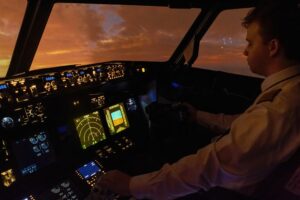
Pilots constantly shift focus between instruments and the outside environment. Stable, reliable vision is essential — particularly in changing conditions.
When Vision Becomes a Limitation
Visual disruption doesn’t happen at convenient times.
It happens when you need clarity most:
- On approach and landing
- During turbulence
- In low-visibility conditions
- When scanning between instruments and the external environment
Even subtle changes can affect:
- Clarity
- Focus
- Reaction time
And in aviation, small delays matter.
Why This Matters for Pilots
Flying requires continuous, stable visual input.
You are constantly switching between:
- Instruments
- The horizon
- Navigation references
- Surrounding traffic
If your vision fluctuates, your workload increases.
You are no longer just flying the aircraft —
you are compensating for your vision.
That added cognitive load is avoidable.
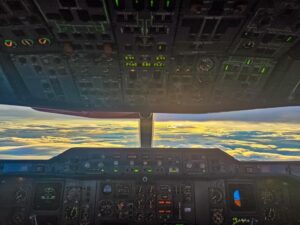
Pilots continuously shift focus between instruments and the outside environment. Stable, consistent vision is essential to maintain accuracy and reduce workload.
Why Pilots Choose Laser Vision Correction
For many pilots, the decision is not about removing glasses.
It’s about removing a variable.
Laser vision correction can provide:
- Stable, consistent vision
- Reduced dependence on external aids
- Greater confidence in changing conditions
This is why many professionals in high-performance environments choose vision correction.
You can see how this applies across other fields:
6 Professions That Benefit Most from LASIK in Sydney
Different environments — same principle:
consistent vision improves performance.
What is the Best Laser Vision Correction Option:
Depending on your eyes and your stage of life, other treatments may be more suitable, including:
- PRK (surface laser treatment)
- KLEx (lenticule extraction eg SMILE Pro)
- Refractive Lens Exchange (RLE) using advanced intraocular lenses (IOLs)
- Implantable collomer lenses (ICL)
A comprehensive assessment helps determine which option will deliver the most stable, high-quality vision for your specific visual demands. Also, please note that CASA requirements differ with various procedures.
Experience Matters: Aviation Expertise You Can Trust
Dr Daya Sharma has been a CASA aviation ophthalmologist since 2011, with over 15 years of experience assessing and managing vision for pilots. Understanding aviation vision standards is a key part of choosing the right procedure. Dr Daya Sharma shares his perspective here: Vision standards for pilots: a surgeon’s perspective
He understands:
- CASA visual standards and certification requirements
- The real-world demands of flying
- The importance of stable vision in dynamic environments
In addition, his work in optimising vision for elite cricketers — where reaction time, clarity, and performance under pressure are critical — directly translates to aviation.
Both environments demand:
- Speed
- Precision
- Consistency
This is not generic refractive surgery.
It is performance-focused vision optimisation.
A Personalised Approach to Laser Vision Correction
Not every pilot is the same.
A comprehensive assessment considers:
- Visual performance in real-world conditions
- Occupational requirements (including CASA considerations)
- Ocular surface health
- Suitability for different laser procedures
In some cases, optimising the ocular surface – including dry eye treatment- is an important first step before surgery.
This ensures the best possible outcome.
View patient case
A pilot presented seeking reduced dependence on glasses, particularly in situations where stable, uninterrupted vision in the cockpit was important.
Following a comprehensive assessment, laser vision correction was performed.
The patient reported clearer, more consistent vision and less reliance on glasses in both daily activities and while flying.
For many pilots, the key benefit is not just convenience, but greater confidence in environments where vision must remain stable under changing conditions.
As with all procedures, outcomes vary and suitability requires an individual assessment.
The Takeaway
For pilots, vision is not just about achieving 6/6 on a chart.
It’s about having reliable, stable vision when conditions are not ideal.
Laser vision correction — when carefully planned and performed — can reduce variability and improve confidence in the cockpit.
Take the Next Step
If you’re a pilot considering laser vision correction, the first step is understanding your suitability.
Book a free suitability consultation NOW
Or complete our online suitability test
Find out if you are suitable for vision correction
Not everyone is eligible for vision correction surgery.
Find out if you could benefit from this life changing surgery by taking the quick self-suitability quiz below: