

Stay Focused on the Road, Not Your Glasses
Whether you’re training before sunrise, climbing through the mountains, riding with friends on weekends or competing in endurance events, cycling places unique demands on your vision.
Every ride requires you to constantly process visual information while travelling at speed.
Road conditions change.
Light changes.
Weather changes.
Traffic changes.
Your eyes are continuously helping you judge distance, anticipate hazards and make rapid decisions.
For many cyclists, glasses and contact lenses work extremely well.
However, others begin exploring vision correction because they become frustrated by fogging lenses, changing between prescription glasses and sunglasses, dry contact lenses or the practical inconvenience of managing eyewear during long rides.
At Eye & Laser Surgeons, we believe choosing vision correction should never be based on your prescription alone.
Instead, we consider your eyes, your cycling and your long-term visual goals before recommending the most appropriate option.
At a Glance
Cyclists commonly ask:
- Can I cycle without glasses?
- Are contact lenses better than glasses for cycling?
- Is LASIK suitable for cyclists?
- Which procedure is most appropriate?
- Can I ride in rain after laser eye surgery?
- How soon can I return to cycling?
- Does cycling influence which treatment is recommended?
The answer depends on:
- your eye health
- your prescription
- your age
- the type of cycling you do
- your visual goals
- your long-term eye health
Why Cyclists Consider Vision Correction
For many cyclists, the decision to explore vision correction begins with everyday practical challenges rather than poor eyesight.
During longer rides, many riders tell us they become increasingly aware of the inconvenience of managing glasses or contact lenses.
Common frustrations include:
- glasses fogging during climbs
- sweat affecting vision
- changing between prescription glasses and sunglasses
- rain on spectacle lenses
- contact lenses becoming dry in windy conditions
- carrying multiple pairs of glasses during long rides
- prescription sunglasses limiting flexibility when light conditions change
These are not necessarily medical problems.
However, they can become practical inconveniences that influence comfort and enjoyment on the bike.
Understanding these challenges is an important part of deciding whether vision correction is appropriate.
Every Cyclist Has Different Priorities
No two cyclists ride in exactly the same way.
A recreational rider completing a weekend café ride has different visual demands from someone descending mountain roads at speed.
A triathlete has different priorities from a commuter.
A gravel rider experiences different environmental conditions from a road cyclist.
Some people simply want greater convenience.
Others prioritise long-term visual quality.
For this reason, our recommendations are always individualised.
We consider not only your prescription but also:
- how often you ride
- whether you compete
- typical riding conditions
- weather exposure
- your occupation
- your future visual needs
- the activities that matter most to you
Common Challenges Cyclists Tell Us About
Every rider experiences different challenges.
However, several themes arise repeatedly during consultations.
Fogging During Climbs
As effort increases, body temperature rises.
Many cyclists notice their glasses fog while climbing, particularly during cooler mornings.
This may temporarily reduce clarity until airflow clears the lenses again.
Wind and Dry Contact Lenses
Long rides often expose the eyes to significant airflow.
Even with wraparound sunglasses, some cyclists notice increasing contact lens dryness towards the end of a ride.
This can become more noticeable during longer endurance events.
Rain and Water on Glasses
Wet roads.
Light drizzle.
Heavy rain.
Water droplets on spectacle lenses may reduce clarity and become another practical distraction during a ride.
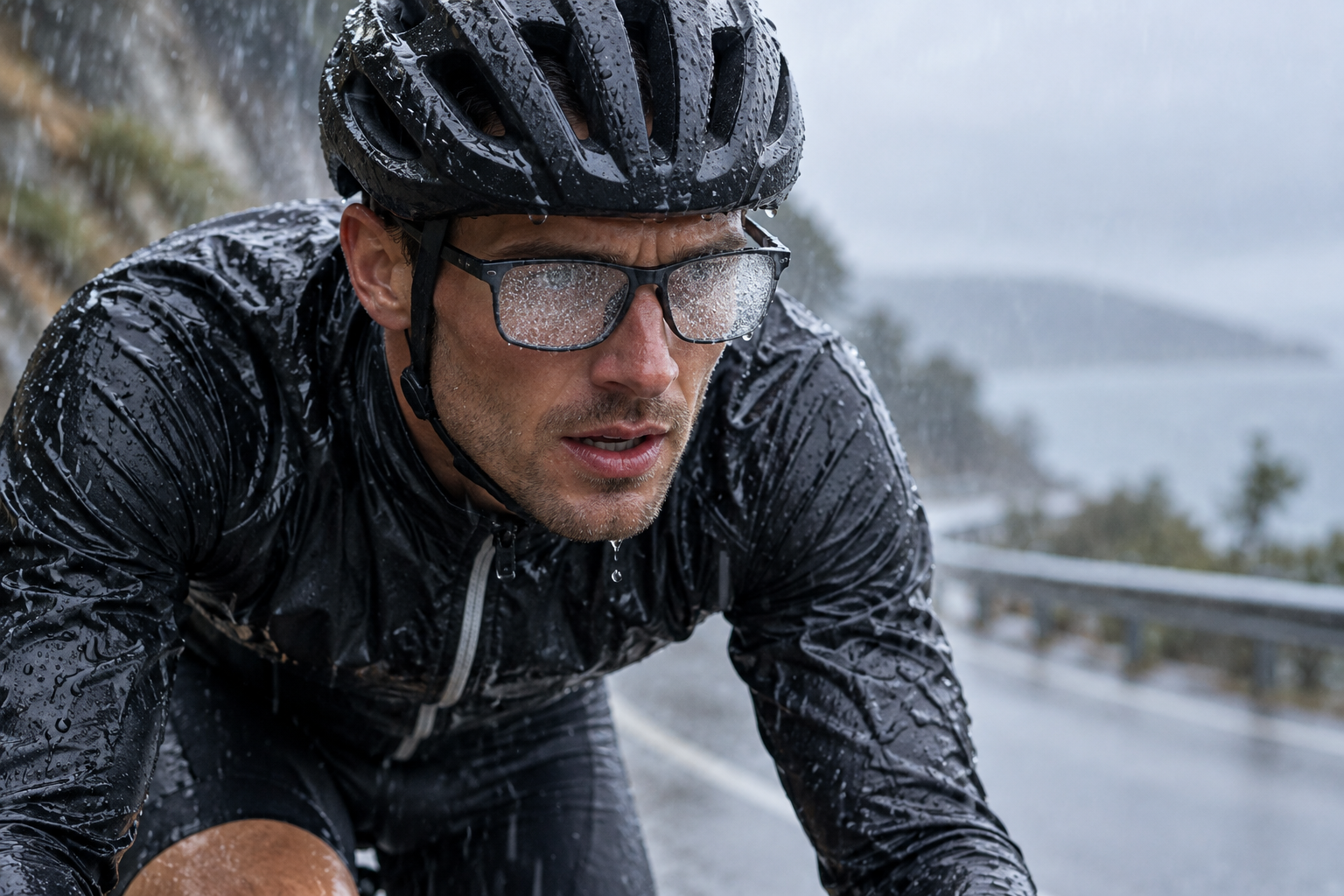
Rain, spray and changing weather conditions can make riding with glasses challenging for some cyclists. Personalised vision correction may reduce dependence on spectacles for suitable candidates following comprehensive assessment.
Constantly Changing Light
Cyclists often ride through:
- early morning sun
- shaded roads
- tunnels
- tree cover
- overcast conditions
- bright afternoon light
Managing different lighting conditions sometimes means carrying multiple pairs of glasses or changing lenses during a ride.
It’s About More Than Cycling
Although cycling may be the reason you first begin exploring vision correction, the decision should support your entire lifestyle.
We also consider how your vision affects:
- driving
- work
- travelling
- family activities
- other sports
- long-term visual goals
The most appropriate recommendation should support your vision both on and off the bike.
Before We Talk About Procedures…
Many cyclists arrive expecting to discuss LASIK.
However, our first question is usually much simpler.
How do you use your vision every day?
Only after understanding your eyes, your cycling and your lifestyle do we begin discussing which vision correction options may be appropriate.
That philosophy guides every recommendation we make.
Choosing the Most Appropriate Vision Correction Option
Many cyclists begin their research by asking:
“Is LASIK the best option for me?”
While LASIK is an excellent treatment for many people, it is only one of several possible vision correction options.
Choosing the most appropriate treatment depends on much more than your prescription.
We also consider:
- your eye health
- corneal thickness and shape
- dry eye symptoms
- your age
- the type of cycling you enjoy
- your occupation
- your future visual needs
- your long-term eye health
Rather than recommending the same procedure for everyone, our goal is to recommend the option that best supports both your lifestyle and your vision for years to come.
How We Assess Cyclists
Every patient undergoes a comprehensive vision correction assessment.
However, cyclists often raise additional practical questions that help guide our discussions.
For example:
- Do you ride before sunrise?
- Do you commute every day?
- Do you compete?
- How many hours each week do you spend on the bike?
- Do your contact lenses become uncomfortable?
- Do your glasses fog during climbs?
- Do changing light conditions affect your vision?
These conversations help us understand not only your eyes, but also how you use your vision on every ride.
Looking Beyond Your Prescription
A comprehensive assessment involves much more than measuring your glasses prescription.
We also evaluate:
- detailed refraction
- tear film quality
- ocular surface health
- pupil size
- retinal health
- binocular vision where appropriate
- discussion of your work, hobbies and sporting activities
Together, these findings help determine which vision correction options may be appropriate for your individual circumstances.
→ Learn more about our Vision Correction Assessment
Understanding Your Vision Correction Options
Different cyclists benefit from different treatments.
The goal is not to recommend the newest procedure.
Nor is it to recommend the procedure we perform most often.
Instead, our role is to recommend the option that best supports your eyes, your cycling and your long-term visual goals.
LASIK
LASIK remains one of the most commonly performed laser vision correction procedures.
For suitable patients, it may reduce dependence on glasses or contact lenses while providing relatively rapid visual recovery.
Many cyclists appreciate the convenience of heading out for a ride without first thinking about prescription glasses or contact lenses.
However, suitability depends on individual assessment rather than lifestyle alone.
SMILE
SMILE is a minimally invasive laser procedure that may be appropriate for selected patients with myopia and certain degrees of astigmatism.
For some cyclists, SMILE may be considered depending on individual eye characteristics.
Whether it is the most appropriate option depends on comprehensive assessment rather than a single factor.
PRK
PRK remains an excellent option for selected patients.
Although visual recovery generally takes longer than LASIK, PRK may be preferred where corneal thickness or other clinical considerations influence treatment selection.
The most appropriate recommendation depends on the overall health of your eyes rather than your sporting activity alone.
Implantable Contact Lenses (ICL)
Some cyclists have prescriptions or eye characteristics that make Implantable Contact Lenses an appropriate option.
Unlike laser procedures, ICL surgery does not reshape the cornea.
Instead, a specially designed lens is implanted inside the eye.
This may be appropriate for selected patients following comprehensive assessment.
→ Learn more about Implantable Contact Lenses
Lens Replacement Surgery
As we age, our natural lens gradually changes.
For some cyclists, particularly those developing presbyopia or early cataracts, Lens Replacement Surgery may provide a more appropriate long-term solution than laser vision correction.
This option is discussed individually where appropriate.
→ Learn more about vision correction for Presbyopia
→ Learn more about Lens Replacement Surgery
Returning to Cycling
One of the most common questions cyclists ask is:
“When can I get back on my bike?”
The answer depends on several factors including:
- the procedure performed
- healing
- environmental conditions
- your type of cycling
- whether you ride recreationally or competitively
- your individual recovery
Some patients return to light indoor cycling relatively quickly.
Others, particularly those riding in dusty, windy or wet conditions, may require a more gradual return.
Your surgeon will discuss an appropriate recovery plan based on your individual treatment and healing.
→ Learn more about Recovery After Vision Correction
Looking Beyond Your Next Ride
Although many cyclists first consider vision correction because of practical frustrations on the bike, our recommendations are never based on cycling alone.
We also consider how your vision supports:
- work
- driving
- travelling
- family life
- other sporting activities
- your future visual needs
Our aim is to recommend a treatment that supports your vision not only on your next ride, but throughout the years ahead.
Questions We Often Discuss During Your Consultation
Every cyclist’s priorities are different.
Some people want greater convenience.
Others are more concerned about dry eyes or changing weather conditions.
Common questions include:
- Which procedure has the shortest recovery?
- Will I still need cycling sunglasses?
- Can I ride in bright sunlight after treatment?
- What happens if my prescription changes later?
- Which option is most appropriate for endurance cycling?
- Does age influence the recommendation?
These conversations form an important part of your consultation because the best recommendation is always individualised.
Shared Decision-Making
At Eye & Laser Surgeons, we believe every patient deserves to understand all appropriate treatment options before making a decision.
Our role is to explain:
- the potential benefits
- the limitations
- the possible risks
- the available alternatives
- and, where appropriate, the option of continuing with glasses or contact lenses.
Together, we can determine the treatment that best supports your eyes, your cycling and your long-term eye health.
Frequently Asked Questions
Can cyclists have laser eye surgery?
Many cyclists are suitable candidates for laser eye surgery.
However, suitability depends on much more than your prescription.
During your assessment we consider your eye health, corneal shape, tear film, lifestyle and the way you use your vision both on and off the bike.
Only after a comprehensive assessment can we determine which vision correction option is most appropriate.
Is LASIK the best procedure for cyclists?
There is no single “best” procedure for every cyclist.
Depending on your eyes and long-term visual goals, LASIK, SMILE, PRK, Implantable Contact Lenses (ICL) or Lens Replacement Surgery may each be appropriate for different people.
Our role is to explain the benefits, limitations and alternatives of every appropriate option before making a recommendation.
Can I cycle after laser eye surgery?
Yes.
Most people return to cycling following recovery.
The timing depends on:
- the procedure performed
- healing
- weather conditions
- the type of cycling you enjoy
- your individual recovery
Your surgeon will discuss when it is appropriate to safely return to riding.
Can I still wear cycling sunglasses?
Absolutely.
Many cyclists continue wearing sunglasses after vision correction.
High-quality cycling sunglasses remain important for:
- UV protection
- wind protection
- insects
- dust
- glare
- flying debris
Vision correction reduces dependence on prescription glasses but does not replace appropriate eye protection.
What if I develop reading glasses later in life?
Laser vision correction does not prevent the normal ageing changes that occur inside the eye.
Many people eventually develop presbyopia after approximately 45 years of age.
For this reason we discuss both your current vision and your long-term visual goals before recommending treatment.
Are contact lenses still a good option?
For many cyclists they are.
If contact lenses remain comfortable and fit your lifestyle they may continue to be an excellent solution.
Vision correction is not appropriate for everyone.
Understanding all appropriate options is an important part of making an informed decision.
Key Takeaways
If you’re a cyclist considering vision correction, remember these key points.
- Every cyclist has different visual requirements.
- Practical inconveniences often lead people to explore vision correction.
- Different procedures suit different eyes.
- Comprehensive assessment is essential before recommending treatment.
- Long-term eye health remains just as important as reducing dependence on glasses.
- Every recommendation should be individualised.
Related Guides
You may also wish to explore:
Vision Correction
- Laser Eye Surgery Sydney
- Vision Correction Assessment
- LASIK
- SMILE
- PRK
- Implantable Contact Lenses (ICL)
- Lens Replacement Surgery
Lifestyle
- Vision Correction for Work, Sport & Active Lifestyles
- Vision Correction for Athletes & Sports Professionals
- Vision Correction for Runners
- Vision Correction for Golfers
- Vision Correction for Tennis Players
- Vision Correction for Sailors & Yachtsmen
- Vision Correction for Swimmers & Triathletes
Your Vision Should Support Every Ride
Whether you’re riding before work, training for your next event or simply enjoying a weekend ride with friends, your vision is an important part of every journey.
Choosing vision correction is about much more than reducing dependence on glasses or contact lenses.
It is about understanding how you use your vision, the practical demands of cycling and which option best supports your long-term visual goals.
At Eye & Laser Surgeons, Dr Daya Sharma believes every patient deserves to understand all appropriate treatment options before making an informed decision.
Rather than recommending the same procedure for everyone, we take the time to understand your eyes, your cycling and your lifestyle.
Together, we can determine the option that best supports both your vision today and your long-term eye health.
Ready to Explore Your Options?
If you’re considering vision correction to support your cycling or active lifestyle, a comprehensive assessment is the first step.
During your consultation we will discuss:
- your eye health
- your prescription
- your cycling
- your work
- your lifestyle
- your long-term visual goals
- the benefits, limitations and alternatives of each appropriate treatment option
Every recommendation is individualised because every cyclist uses their vision differently.
Vision Correction for Cyclists: Key Points
If you’re a cyclist considering vision correction:
- Practical issues such as fogging glasses, changing lenses and contact lens discomfort are common reasons people explore treatment.
- Different procedures suit different eyes.
- Comprehensive assessment considers your eye health, lifestyle and the type of cycling you enjoy.
- LASIK is only one of several possible options.
- Long-term eye health is just as important as reducing dependence on glasses.
- Every recommendation should be personalised.