

When You’re Thinking About Your Next Shot, You Shouldn’t Be Thinking About Your Glasses.
Tennis is a sport of constant movement, rapid reactions and split-second decisions.
Players track a fast-moving ball, adjust their court position, judge depth and react to changing angles throughout every rally.
For many people, glasses or contact lenses work extremely well.
However, some players begin exploring vision correction because they find glasses slipping with sweat, contact lenses becoming uncomfortable during long matches or simply want greater convenience on court.
At Eye & Laser Surgeons, we believe choosing vision correction should never be based on your prescription alone.
Instead, we consider your eyes, the way you play tennis and your long-term visual goals before recommending the most appropriate option.
At a Glance
Tennis players commonly ask:
- Can I play tennis without glasses?
- Are contact lenses better than glasses for tennis?
- Is LASIK suitable for tennis players?
- Which procedure is most appropriate?
- How soon can I return to playing?
- Does playing tennis influence which treatment is recommended?
The answer depends on:
- your eye health
- your prescription
- your age
- how often you play
- your visual goals
- your long-term eye health
Why Tennis Players Consider Vision Correction
Many people initially explore vision correction for a very practical reason.
They simply want to spend less time thinking about their glasses.
For some players this means:
- glasses slipping during rallies
- lenses fogging in humid conditions
- changing between prescription glasses and sunglasses
- contact lenses becoming dry during long matches
- worrying about damaging glasses during competition
- carrying multiple pairs of glasses to training
These are not medical problems.
However, they may become practical inconveniences that influence the way people enjoy their sport.
Understanding these challenges is an important part of deciding whether vision correction is appropriate.

During a tennis serve, even a brief distraction to adjust slipping glasses can interrupt concentration. For suitable candidates, personalised vision correction may reduce dependence on glasses or contact lenses while supporting an active lifestyle.
Every Tennis Player Has Different Priorities
No two players use their vision in exactly the same way.
A junior player learning technique has different visual requirements from someone competing every weekend.
A doubles player constantly monitors both opponents while remaining aware of their partner.
A singles player may spend longer tracking the ball across the court during extended rallies.
Some people simply want greater convenience.
Others prioritise long-term visual quality.
For this reason, our recommendations are always individualised.
We consider not only your prescription but also:
- how often you play
- whether you compete
- your work
- your hobbies
- your future visual needs
- the activities that matter most to you
Common Challenges We Hear From Tennis Players
During consultations, many tennis players describe similar practical frustrations.
Glasses That Slip During Play
As rallies become longer and body temperature rises, glasses may gradually slide down the nose.
Many players instinctively interrupt their concentration to adjust them.
Although this may seem like a small inconvenience, repeated interruptions can become frustrating over time.
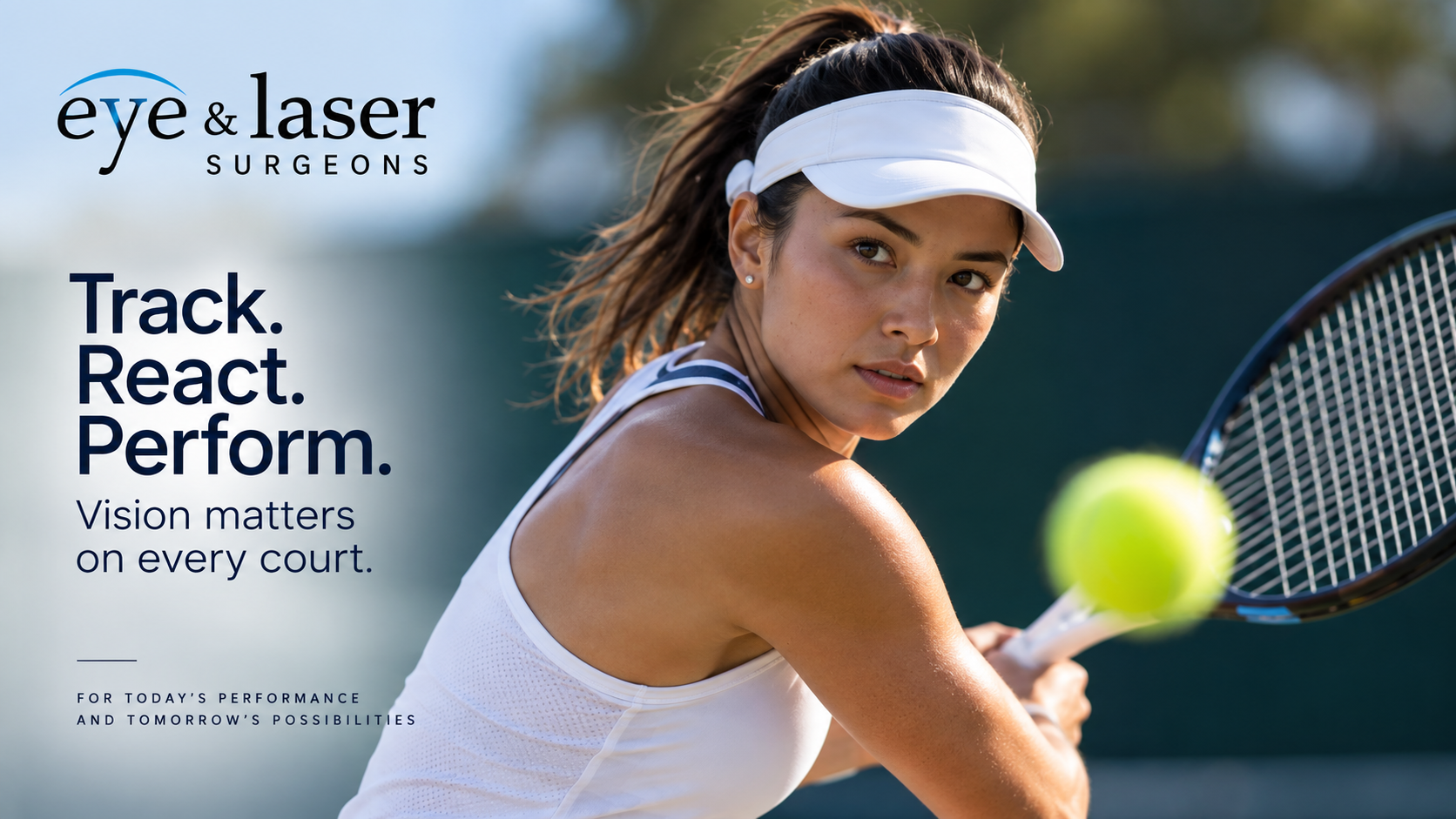
Vision matters on every court.
Contact Lenses Becoming Dry
Outdoor courts, wind and long matches may cause contact lenses to become less comfortable for some people.
Many players find themselves blinking more frequently or using lubricating drops between sets.
Changing Between Prescription Glasses and Sunglasses
Bright afternoon matches often mean switching between prescription glasses and prescription sunglasses.
Some players simply prefer the convenience of reducing the number of visual aids they need to carry.
Playing in Different Conditions
Morning matches.
Afternoon sun.
Indoor courts.
Artificial lighting.
Different conditions may all influence visual comfort.
When planning vision correction we discuss where and how you play, not simply what prescription you have.It’s About More Than Tennis
Although tennis may be the reason you begin exploring vision correction, the decision should also support the rest of your life.
We consider whether treatment will help you enjoy:
- work
- driving
- travelling
- family activities
- exercise
- other sports
- long-term visual goals
The most appropriate recommendation should support your vision both on and off the court.
Tennis Is Only Part of the Conversation
Many patients arrive expecting to discuss LASIK.
However, before talking about procedures we first ask a different question:
How do you use your vision every day?
Only after understanding your eyes, your tennis and your lifestyle do we begin discussing which vision correction options may be appropriate.
That philosophy guides every recommendation we make.
Choosing the Most Appropriate Vision Correction Option
Many tennis players begin their research by asking a simple question:
“Is LASIK the best option for me?”
The answer is not always straightforward.
While LASIK is an excellent treatment for many people, it is only one of several vision correction options.
Choosing the most appropriate procedure depends on much more than your prescription.
We consider:
- your eye health
- your corneal shape and thickness
- tear film quality
- age
- your long-term visual goals
- how often you play tennis
- whether you compete
- your occupation
- other activities that are important to you
Rather than recommending the same procedure for everyone, we believe the most appropriate treatment is the one that best supports both your lifestyle and the long-term health of your eyes.
How We Assess Tennis Players
Every patient undergoes a comprehensive vision correction assessment.
However, for people who regularly play tennis, we also discuss the practical demands that the sport places on vision.
These conversations often include:
- how often you play
- whether you compete socially or competitively
- outdoor or indoor courts
- daytime or evening matches
- previous contact lens wear
- dry eye symptoms
- your expectations after treatment
Understanding these factors helps us tailor recommendations to your individual circumstances rather than relying on your prescription alone.
A Comprehensive Assessment Looks Beyond Your Prescription
Choosing the most appropriate treatment begins with understanding your eyes.
Your assessment may include:
- detailed refraction
- corneal topography and tomography
- tear film assessment
- pupil measurements
- retinal examination
- ocular health assessment
- discussion of your lifestyle and sporting activities
Together, these findings help determine which treatment options may be appropriate for you.
→ Learn more about our Vision Correction Assessment
Understanding Your Vision Correction Options
Different patients benefit from different treatments.
The aim is not to recommend the newest procedure or the most commonly performed procedure.
Instead, our goal is to recommend the option that best matches your eyes, your lifestyle and your long-term visual needs.
LASIK
LASIK remains one of the most commonly performed forms of laser vision correction.
For suitable patients, it may reduce dependence on glasses or contact lenses while offering relatively rapid visual recovery.
Many active people appreciate returning to everyday activities soon after treatment.
However, suitability depends on individual assessment rather than lifestyle alone.
SMILE
SMILE is a minimally invasive laser procedure that may be appropriate for selected patients with myopia and certain degrees of astigmatism.
For some active people, SMILE may offer advantages depending on their individual eyes.
Whether SMILE is the most appropriate option can only be determined following comprehensive assessment.
PRK
PRK remains an excellent treatment option for selected patients.
Although visual recovery generally takes longer than LASIK, PRK may be preferred where corneal characteristics or other clinical considerations influence treatment selection.
Implantable Contact Lenses (ICL)
Some tennis players have prescriptions or eye characteristics that make Implantable Contact Lenses an appropriate option.
Unlike laser procedures, ICL surgery does not reshape the cornea.
Instead, a specialised lens is placed inside the eye.
Whether this option is suitable depends on your prescription, eye health and comprehensive assessment.
→ Learn more about Implantable Contact Lenses
Lens Replacement Surgery
As we age, the natural lens changes.
For some patients, particularly those beginning to experience presbyopia or early cataracts, Lens Replacement Surgery may provide a more appropriate long-term solution than laser vision correction.
This option is discussed individually where appropriate.
→ Learn more about Lens Replacement Surgery
Returning to Tennis
One of the most common questions we hear is:
“When can I play tennis again?”
The answer depends on several factors including:
- the procedure performed
- healing
- the intensity of your training
- whether you compete
- environmental conditions
- your individual recovery
For some people, returning to light activity occurs relatively quickly.
Others, particularly those participating in competitive tennis, may require a more gradual return.
Dr Daya Sharma will explain the expected recovery timeline and advise when it is appropriate to resume training and competition.
Looking Beyond Your Next Match
Although many people initially seek vision correction to improve convenience during tennis, our recommendations are never based on tennis alone.
We also consider:
- your work
- driving
- reading
- digital device use
- travelling
- family life
- future vision changes
Our goal is to recommend a treatment that supports your vision not only during your next match but throughout the years ahead.
Common Questions We Discuss During Your Consultation
Many tennis players ask questions such as:
- Will I still need sunglasses?
- Can I wear protective eyewear after treatment?
- Is laser vision correction better than contact lenses for tennis?
- Which option offers the quickest recovery?
- What happens if my prescription changes later?
- Will age influence which procedure is recommended?
- Which is best LASIK Vs SMILE Vs PRK Vs ICL
These questions form an important part of your consultation because every recommendation should be based on your individual needs rather than a standard treatment pathway.
Choosing the Most Appropriate Treatment Is a Shared Decision
At Eye & Laser Surgeons, we believe patients should understand all appropriate treatment options before making a decision.
Our role is to explain:
- the benefits
- the limitations
- the potential risks
- the alternatives
- the option of continuing with glasses or contact lenses where appropriate
Together, we can decide which option best supports your eyes, your lifestyle and the activities that matter most to you.
Frequently Asked Questions
Can tennis players have laser eye surgery?
Many tennis players are suitable candidates for laser eye surgery. However, suitability depends on much more than your prescription.
During your suitability assessment we consider your eye health, corneal shape, tear film, visual goals and the way you use your vision during both tennis and everyday life.
The most appropriate treatment can only be determined following a comprehensive assessment.
Is LASIK the best procedure for tennis players?
There is no single “best” procedure for every tennis player.
Depending on your eyes and lifestyle, LASIK, SMILE, PRK, Implantable Contact Lenses (ICL) or Lens Replacement Surgery may each be appropriate for different people.
Our role is to explain the benefits, limitations and alternatives of every appropriate option before making a recommendation.
Will vision correction improve my tennis?
Vision correction aims to reduce dependence on glasses or contact lenses for suitable candidates.
Many people appreciate the convenience of playing tennis without glasses or contact lenses.
However, treatment should not be viewed as a guarantee of improved sporting performance.
Every player’s eyes, visual requirements and sporting goals are different.
Can I wear sunglasses after laser eye surgery?
Yes.
Many tennis players continue to wear sunglasses after treatment to reduce glare and improve comfort in bright outdoor conditions.
Protecting your eyes from ultraviolet (UV) exposure remains important regardless of whether you have undergone vision correction.
When can I return to tennis?
Recovery varies depending on the procedure performed, your healing and the level of tennis you play.
Some patients return to light activity relatively quickly, while others require a more gradual return.
During your consultation we will discuss realistic recovery timelines and advise when it is appropriate to safely resume training and competition.
What if I develop reading glasses later in life?
Laser eye surgery does not prevent the normal ageing changes that occur within the eye.
Many people eventually develop presbyopia, which affects near focusing after approximately 45 years of age.
During your assessment we discuss both your current vision and your future visual needs so that recommendations support your long-term goals.
Can contact lenses still be a good option?
Absolutely.
For many tennis players, contact lenses remain an excellent solution.
If contact lenses continue to provide comfortable vision and suit your lifestyle, they may remain the most appropriate option.
Our goal is not to recommend surgery for everyone.
Our goal is to help you understand all appropriate options.
Key Takeaways
If you are a tennis player considering vision correction, remember these key points.
- Good tennis vision involves much more than reading an eye chart.
- Practical issues such as slipping glasses or uncomfortable contact lenses are often the reason people explore vision correction.
- Different procedures suit different eyes.
- Comprehensive assessment is essential before recommending treatment.
- Long-term eye health is just as important as reducing dependence on glasses.
- Every recommendation should be individualised.
Related Guides
You may also find these resources helpful.
Vision Correction
- Laser Eye Surgery Sydney
- Vision Correction Assessment
- LASIK
- SMILE
- PRK
- Implantable Contact Lenses (ICL)
- Lens Replacement Surgery
- LASIK Vs SMILE Vs PRK Vs ICL
Sports Vision
- Vision Correction for Athletes & Sports Professionals
- Vision Correction for Work, Sport & Active Lifestyles
- Vision Correction for Cricket Players
- Vision Correction for Golfers
- Vision Correction for Swimmers & Triathletes
- Vision Correction for Cyclists
- Vision Correction for Sailors & Yachtsmen
- Vision Correction for Contact Sports
Your Vision Should Support the Way You Play
Whether you compete every weekend or simply enjoy a social hit with friends, your vision plays an important role in the way you experience tennis.
Choosing vision correction is about much more than reducing dependence on glasses or contact lenses.
It is about understanding how you use your vision, the practical demands of your sport and which option best supports your long-term visual goals.
At Eye & Laser Surgeons, we believe every patient deserves to understand all appropriate treatment options before making an informed decision.
Our role is not simply to recommend a procedure.
Our role is to help you understand your options so that together we can determine the treatment that best supports your eyes, your lifestyle and your future.
Ready to Explore Your Options?
If you are considering vision correction to support your tennis, work or active lifestyle, a comprehensive assessment is the first step.
During your consultation we will discuss:
- your eye health
- your prescription
- your lifestyle
- your sporting activities
- your long-term visual goals
- the benefits, limitations and alternatives of each appropriate treatment option
Together, we can develop a personalised plan based on your eyes and the activities that matter most to you.
Vision Correction for Tennis Players: Key Points
If you are a tennis player considering vision correction:
- Practical issues such as slipping glasses and contact lens discomfort are common reasons people explore treatment.
- Different vision correction options suit different eyes.
- LASIK is only one of several possible treatments.
- A comprehensive assessment considers your eye health, lifestyle and the way you play tennis.
- The most appropriate recommendation supports both your current sporting activities and your long-term eye health.