Presbyopic Vision Correction: Modern Laser Vision Correction for Reading Glasses After 40
Can laser vision correction reduce dependence on reading glasses?
Yes. Modern laser vision correction may reduce dependence on reading glasses for carefully selected patients. However, no laser procedure can stop or reverse the natural ageing process that causes presbyopia.
Many people first notice presbyopia during their forties. Restaurant menus become harder to read, mobile phones gradually move further away and computer work often becomes more tiring. Although these changes can feel frustrating, they are a normal part of the ageing process rather than a disease.
Presbyopia develops because the eye’s natural crystalline lens gradually becomes less flexible throughout life. As the lens stiffens, it loses its ability to change shape and focus comfortably on nearby objects. This process continues whether or not laser vision correction has been performed.
Traditional laser vision correction procedures, including LASIK, SMILE and PRK, reshape the cornea to correct refractive errors such as myopia (short-sightedness), hyperopia (long-sightedness) and astigmatism. These procedures improve the way light focuses on the retina, but they do not restore the flexibility of the ageing natural lens.
Fortunately, refractive surgery has continued to evolve.
Today, modern presbyopic vision correction includes several advanced strategies that may reduce dependence on reading glasses while maintaining excellent quality of vision. These include monovision laser vision correction, PresbyLASIK (PresbyLaser), blended vision strategies and, for some patients, lens-based vision correction such as Refractive Lens Exchange.
Rather than treating every patient in exactly the same way, modern presbyopic vision correction aims to provide the best balance between distance, intermediate and near vision according to each person’s lifestyle, occupation and long-term visual goals.
At Eye & Laser Surgeons, we believe there is rarely one “best” treatment for presbyopia. Instead, the most appropriate option depends on your prescription, the health of your cornea, the condition of your natural lens, your occupation, your hobbies and how you use your vision every day.
Our role is not simply to recommend a procedure. Our role is to help you understand your eyes, explain every appropriate option and guide you towards the treatment that best matches both your current visual needs and your future vision.
If you are beginning to explore your options, we recommend first reading our comprehensive guide to Laser Eye Surgery & Vision Correction. You may also find our comparison of LASIK, SMILE and PRK helpful before learning how these procedures can be adapted to help manage presbyopia.
Why do we eventually need reading glasses?
One of the most remarkable features of the human eye is its ability to change focus almost instantly.
This process is called accommodation. It allows us to look effortlessly from the horizon to a computer screen, a book or the display on a mobile phone.
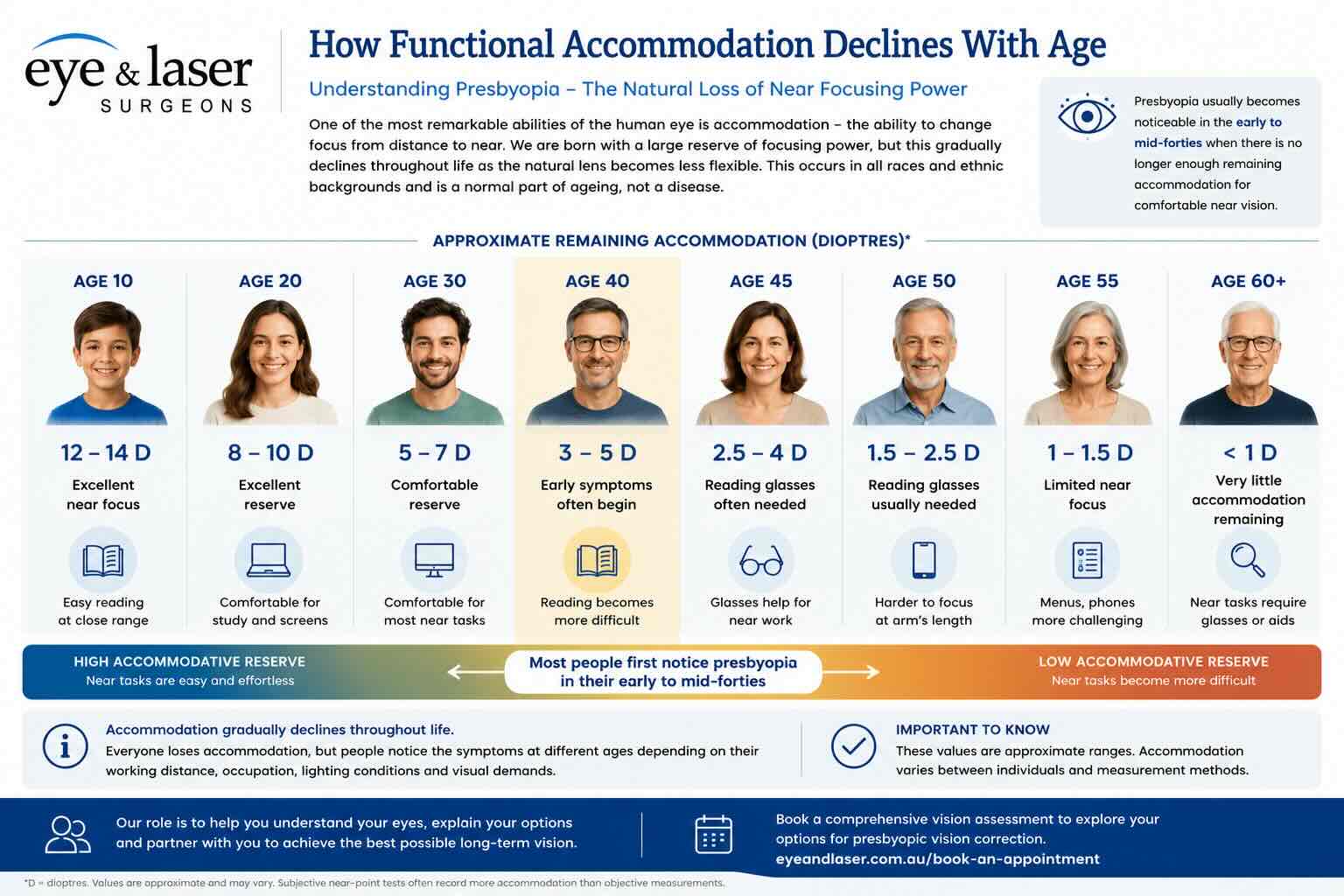
How accommodation changes with age
When we are young, the natural crystalline lens is soft and flexible. Tiny muscles inside the eye continually change the shape of the lens, allowing clear vision across a wide range of distances.
Over time, however, the lens gradually becomes firmer and less elastic. Every year, it loses a small amount of its focusing ability. This change occurs in everyone. It is a normal biological process rather than a disease.
When does presbyopia begin?
Most people are unaware that these changes have been occurring for many years before they notice the first symptoms.
During our twenties and thirties we usually retain enough accommodative reserve for comfortable reading and computer work. Eventually, however, the remaining focusing ability becomes insufficient for comfortable near vision. This usually occurs during the early to mid-forties.
Many people first notice that they need brighter light to read. Others begin holding books further away or increasing the font size on their phone. Reading for long periods often becomes more tiring, even though distance vision may remain excellent.
This gradual loss of near focusing ability is called presbyopia.
Importantly, presbyopia is not caused by weak eye muscles, excessive screen use or reading in poor light. Instead, it develops because the natural crystalline lens continues to lose flexibility throughout life.
Why people experience presbyopia differently
Some people primarily struggle with reading. Others find computer work more difficult. Some patients want greater freedom for golf, cycling or travel, while others require excellent binocular vision for occupations such as aviation, surgery or emergency services.
For this reason, successful presbyopic vision correction involves much more than correcting a prescription. It requires understanding how you use your vision every day and how your eyes are likely to change in the future.
At Eye & Laser Surgeons, every recommendation begins with understanding your individual visual needs before discussing whether reading glasses, monovision, PresbyLASIK, blended vision, Implantable Collamer Lens (ICL), Refractive Lens Exchange or another vision correction strategy may be most appropriate.
How modern vision correction helps people with presbyopia
Although no treatment can make the ageing natural lens young again, modern vision correction can reduce many of the everyday frustrations caused by presbyopia.
Rather than trying to restore accommodation, today’s treatments aim to improve the way the entire visual system functions across different viewing distances.
For some people, the priority is reading without glasses. Others spend most of the day using computers, while many simply want to enjoy everyday activities with less dependence on spectacles.
Successful presbyopic vision correction therefore involves much more than reading the smallest letters on an eye chart. It aims to provide comfortable, functional vision for the way you actually live.
Modern treatment strategies may include laser vision correction, lens-based procedures or simply continuing with glasses, depending on your individual needs.
Before recommending any treatment, we first understand your eyes, your lifestyle and your long-term visual goals. There is however. no treatment option that gives you back the vision you had as a child.
Your options for reducing dependence on reading glasses
There is no single treatment that suits everyone with presbyopia.
The most appropriate option depends on much more than your age or whether you currently wear reading glasses. We consider how you use your vision every day, your prescription, the health of your eyes, your occupation, hobbies and long-term visual goals before discussing which options may be appropriate.
Modern presbyopic vision correction includes several different strategies. Some involve laser vision correction, while others involve replacing the eye’s natural lens. For many people, continuing with reading glasses remains the simplest and most appropriate solution.
Our philosophy is simple. We explain every suitable option, discuss the potential benefits, limitations, risks and alternatives, and help you make an informed decision that best matches your individual eyes.
PresbyLASIK (PresbyMAX) Extended depth of focus laser treatment
PresbyLASIK represents one of the most exciting developments in modern laser vision correction. PresbyLASIK is an advanced form of laser vision correction designed to improve functional vision across more than one viewing distance.
Rather than creating a single focal point, PresbyLASIK reshapes the cornea using advanced optical treatment profiles designed to increase the functional range of vision in each eye.
At Eye & Laser Surgeons, Dr Daya Sharma performs PresbyMAX treatments using the Schwind Amaris 1050RS laser. PresbyMAX combines an extended-depth-of-focus treatment profile with laser blended vision, allowing the two eyes to work together to provide a useful range of distance, intermediate and near vision.
Different PresbyMAX treatment strategies can be selected according to a person’s age, prescription, eye dominance, visual priorities and tolerance of differences between the two eyes.
The objective is not necessarily perfect vision at every distance. The aim is to provide a practical range of vision for everyday activities while reducing dependence on reading glasses, multifocal glasses or contact lenses. Glasses may still be required for some tasks.
Technology does not replace careful assessment or clinical judgement. Successful treatment depends on selecting an appropriate treatment strategy for the individual patient, rather than choosing a procedure simply because the technology is available.
PresbyMAX may suit people who:
Rely on reading glasses or multifocal glasses.
Have healthy corneas and otherwise suitable eyes.
Would like greater independence across multiple viewing distances.
Understand that no procedure can guarantee complete freedom from glasses.
Accept that there may be visual compromises when extending the range of vision.
laser BLENDED vision correction
Monovision is one of the longest-established laser strategies for reducing dependence on reading glasses.
One eye is corrected primarily for distance vision while the other is adjusted for near or intermediate vision. The brain gradually combines information from both eyes, allowing many people to function comfortably across a wide range of everyday activities.
Many patients adapt extremely well. Others notice compromises in depth perception or binocular vision, particularly during visually demanding tasks. For this reason, careful patient selection remains essential.
Where appropriate, we may recommend a contact lens trial before considering permanent treatment.
Monovision may suit people who:
Wish to reduce dependence on reading glasses.
Have previously adapted well to monovision contact lenses.
Value convenience for everyday activities.
Understand that some visual compromise may be necessary.
Learn more about Laser Vision Correction
Continue with reading glasses
Reading glasses remain an excellent option for many people with presbyopia.
They provide reliable near vision, involve no surgical risk and can be updated easily as your eyes naturally change over time.
Many patients choose reading glasses because they are simple, effective and allow excellent distance vision without unnecessary intervention.
This option may suit people who:
- Only need occasional help for reading.
- Prefer not to have a procedure.
- Have minimal symptoms.
- Are comfortable wearing glasses for near tasks.
Lens-based vision correction
For some patients, replacing the eye’s natural lens provides a better long-term solution than reshaping the cornea.
Refractive Lens Exchange (RLE) replaces the ageing crystalline lens with an artificial intraocular lens. Depending on the lens selected, this may improve distance, intermediate and near vision while also preventing future cataract surgery because the natural lens has already been replaced.
Modern multifocal and extended depth of focus (EDOF) intraocular lenses offer additional options for carefully selected patients seeking greater spectacle independence.
Lens-based vision correction may suit people who:
- Have more advanced presbyopia.
- Are beginning to develop early cataracts.
- Prefer a lens-based rather than corneal solution.
- Would benefit from correcting both their prescription and their ageing natural lens.
Choosing between laser vision correction and lens-based surgery requires a comprehensive assessment. Our role is to explain which options may be appropriate, why we recommend them, and how they fit your long-term visual needs.
Which vision correction option may suit your lifestyle?
Presbyopia affects almost everyone. However, it does not affect everyone in the same way.
Two people with exactly the same prescription may receive completely different recommendations because they use their vision differently every day.
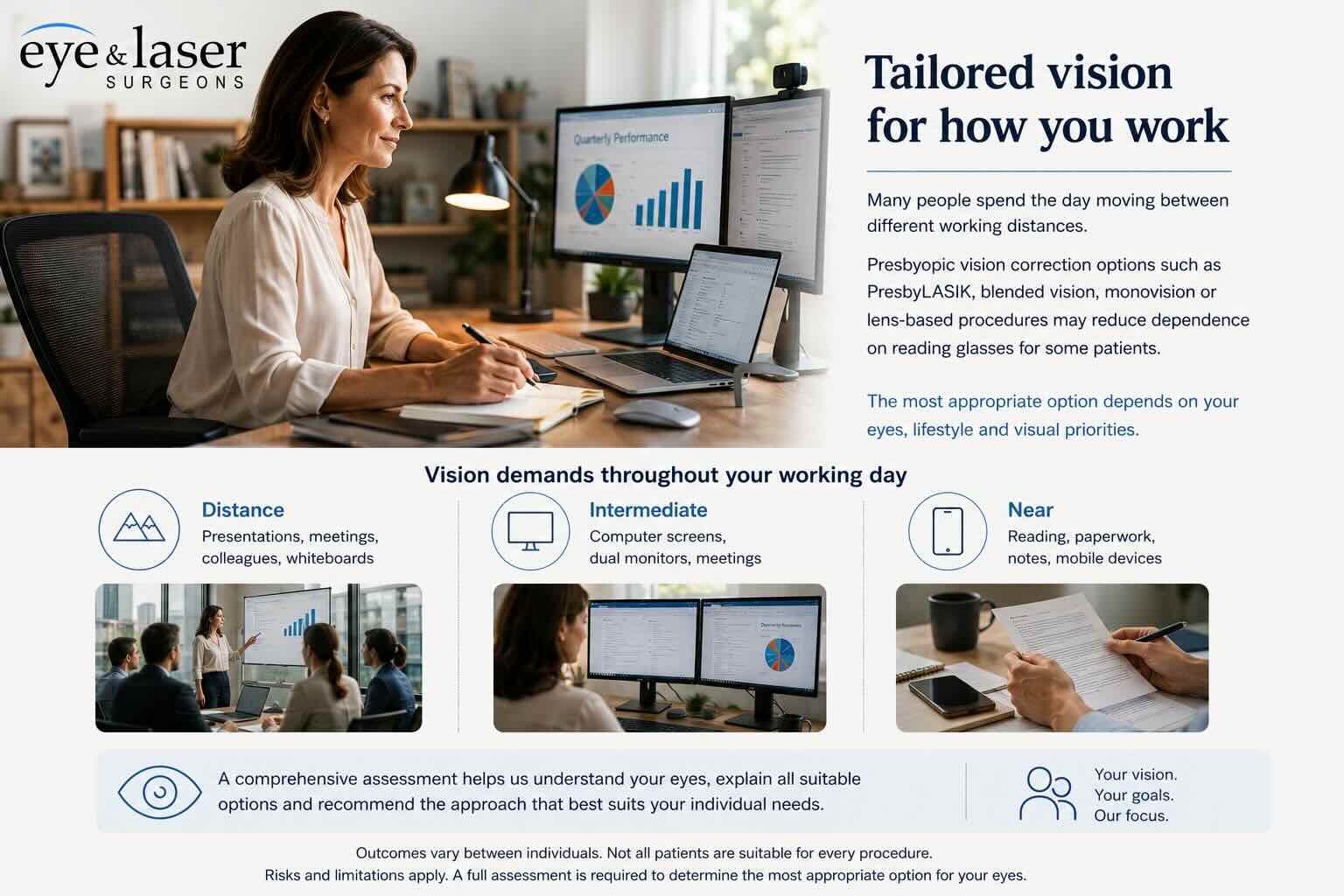
Some people spend long hours working on computers. Others play golf several times each week, travel frequently or enjoy an active lifestyle. Pilots, surgeons, dentists, emergency service personnel and other professionals often have particularly demanding visual requirements.
Although these patients may all develop presbyopia, the most appropriate vision correction strategy may be very different for each individual.
At Eye & Laser Surgeons, we believe successful vision correction begins with understanding how you use your eyes every day. We then recommend the option that best supports your lifestyle, occupation and long-term visual goals.
You can also explore our guide to Vision Correction for Work, Sport & Active Lifestyles.
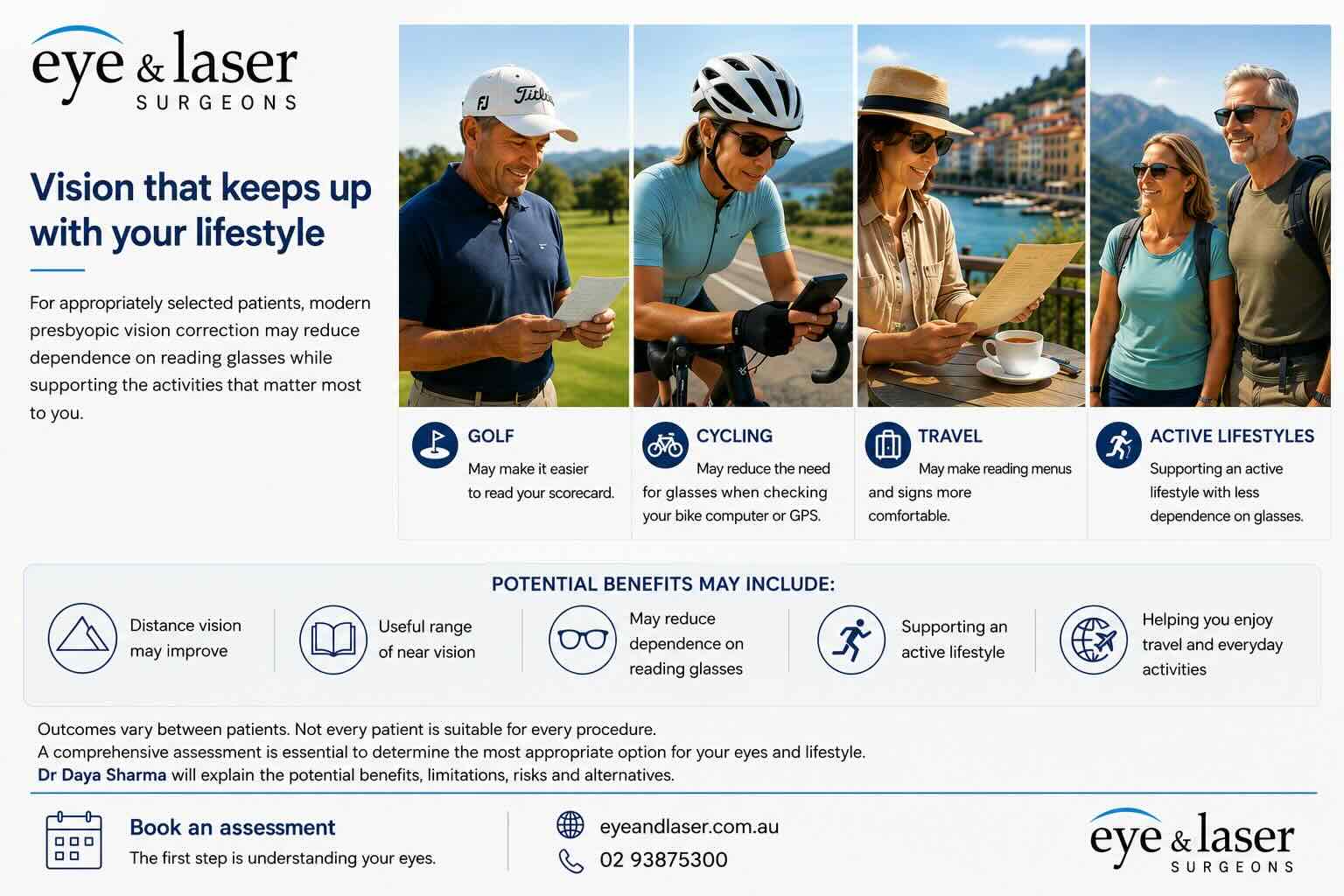
Golfers, cyclists, athletes travellers and active lifestyles
Many active people would like greater freedom from glasses while maintaining excellent distance vision for sport, driving and travel.
At the same time, they often want to read a scorecard, mobile phone, GPS or restaurant menu without constantly searching for reading glasses.
Rather than maximising one focal point, modern presbyopic vision correction aims to provide a practical balance between distance, intermediate and near vision.
Lifestyle therefore plays an important role when deciding whether reading glasses, PresbyLASIK, monovision or another treatment may be the most appropriate option.
Learn more about Vision Correction for Sport & Active Lifestyles.
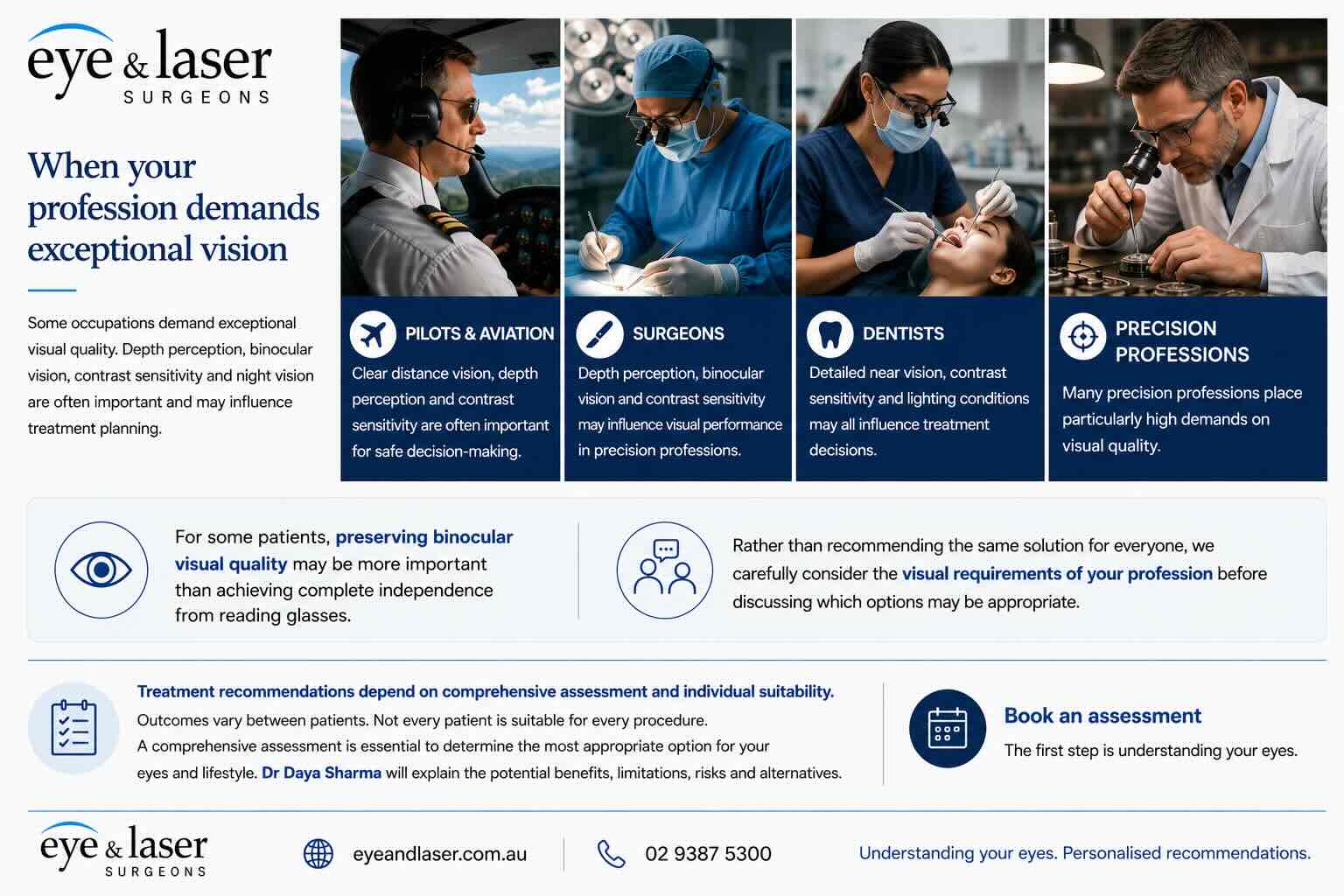
Pilots, surgeons, dentists and other precision professions
Some occupations demand exceptional visual quality.
Depth perception, binocular vision, contrast sensitivity and night vision may all influence treatment planning.
For these patients, the decision is rarely straightforward.
Rather than recommending the same solution for everyone, we carefully consider the visual requirements of your profession before discussing which options may be appropriate.
For some patients, preserving binocular visual quality may be more important than achieving complete independence from reading glasses.
Police, emergency services and physically demanding occupations
Police officers, firefighters, paramedics and emergency service personnel often work in unpredictable environments where glasses may fog, move or become damaged.
Similarly, many tradespeople and people with physically demanding occupations value the convenience of reducing dependence on spectacles while maintaining reliable vision throughout the working day.
The most appropriate treatment depends on balancing visual quality, safety and long-term eye health rather than simply choosing the latest procedure.

Patients over 50 or developing early cataracts
As the natural crystalline lens continues to age, laser vision correction is not always the most appropriate long-term solution.
For some patients, Refractive Lens Exchange may provide better long-term vision by correcting both the prescription and the ageing lens responsible for presbyopia.
Understanding when laser vision correction and when lens-based surgery becomes the better option is an important part of comprehensive refractive assessment.
Why there is rarely one “best” treatment
Many people ask:
“Which treatment is best for reading glasses?”
We believe the better question is:
“Which treatment is most appropriate for my eyes?”
Although almost everyone develops presbyopia, every patient experiences it differently.
Your prescription is only one part of the decision.
We also consider:
- Your age.
- Your remaining focusing ability.
- Your corneal shape and thickness.
- The health of your ocular surface.
- The condition of your natural crystalline lens.
- Your occupation.
- Your sporting activities.
- Your hobbies.
- Your night vision requirements.
- Your long-term visual goals.
Only after understanding these factors do we discuss which treatments may be appropriate.
For one patient, reading glasses may remain the best option.
Another may benefit from monovision laser vision correction.
Someone else may be better suited to PresbyLASIK.
Another patient may achieve the best long-term outcome with Refractive Lens Exchange.
Our philosophy is simple.
We do not recommend the newest technology simply because it is new.
We recommend the treatment that best matches your individual eyes, your lifestyle and your future vision.
How technology is changing presbyopic vision correction
Modern technology has transformed the way we assess, plan and perform laser vision correction. However, technology alone does not determine the most appropriate treatment.
At Eye & Laser Surgeons, we believe technology should help answer important clinical questions rather than replace clinical judgement. Every investigation provides another piece of information about your eyes, allowing us to recommend the treatment that best matches your prescription, lifestyle and long-term visual goals.
Rather than relying on a single measurement, we combine advanced imaging, diagnostic testing and clinical examination to understand how your entire visual system functions.
Understanding the cornea
The cornea provides around two-thirds of the eye’s focusing power. Before considering any laser vision correction procedure, we need to understand its shape, thickness and long-term stability.
Modern corneal topography and tomography create highly detailed three-dimensional maps of the cornea. These scans help us detect subtle irregularities that may influence both safety and treatment planning.
They also help determine whether laser vision correction is appropriate and, if so, which treatment strategy may best suit your eyes.
Looking beyond your glasses prescription
A standard glasses prescription measures refractive error. However, it does not describe every aspect of the way light passes through the eye.
Where appropriate, wavefront analysis allows us to evaluate higher-order optical imperfections that may influence visual quality, contrast sensitivity and night vision.
These measurements help us individualise treatment planning and better understand how your eyes perform in everyday situations—not just on an eye chart.
Advanced laser platforms and customised treatment planning
Laser technology continues to evolve rapidly.
Modern femtosecond laser systems allow increasingly precise treatment planning while supporting more customised approaches to refractive surgery.
The ZEISS VISUMAX 800 represents one of the latest developments in femtosecond laser technology. As refractive surgery continues to advance, platforms such as the VISUMAX 800 may support increasingly sophisticated approaches to PresbyLASIK, blended vision strategies and future laser treatments for presbyopia.
Although advanced technology creates new possibilities, successful treatment still depends on careful patient selection, thoughtful planning and clinical experience rather than the laser alone.
Extended Depth of Focus (EDOF) and modern corneal optics
One of the most significant advances in presbyopic laser vision correction has been the development of optical strategies that increase the eye’s functional range of focus.
Rather than producing a single focal point, some modern PresbyLASIK techniques aim to create a broader range of clear vision using principles such as Extended Depth of Focus (EDOF) and blended vision.
Depending on the treatment strategy, these approaches may improve distance, intermediate and near vision while reducing dependence on reading glasses.
Different PresbyLASIK techniques use different optical designs. The most appropriate approach depends on the individual patient’s eyes rather than the technology itself.
Why the ocular surface matters
The tear film forms the eye’s first focusing surface.
If the tear film is unstable, vision may fluctuate and important measurements can become less reliable. Dry eye may also influence comfort and visual recovery after laser vision correction.
For this reason, we routinely assess the ocular surface as part of a comprehensive refractive evaluation. Where appropriate, treating dry eye before surgery may improve both measurement accuracy and postoperative comfort.
Learn more about our approach to Dry Eye and Ocular Surface Disease and IPL treatment for evaporative dry eye.
Technology supports better decisions—it never replaces them
Every investigation contributes another piece of information about your eyes.
Together, these measurements help us understand your prescription, corneal shape, tear film, natural lens, retinal health and the overall quality of your vision.
However, no machine can determine which treatment is right for you.
Our recommendation always combines advanced technology with careful clinical assessment, your visual priorities and an open discussion about the benefits, limitations, risks and alternatives of every appropriate treatment.
We believe technology should support better decisions, never replace thoughtful clinical judgement. That philosophy allows us to provide genuinely personalised presbyopic vision correction rather than simply offering the latest procedure.
How do we determine which presbyopic vision correction option may be most appropriate?
Choosing the most appropriate treatment for presbyopia involves much more than measuring your glasses prescription.
Every patient uses their vision differently. Daily activities, occupation, hobbies and long-term visual goals all influence which option may provide the best balance between distance, intermediate and near vision.
For this reason, we never begin by recommending a procedure.
Instead, we begin by understanding your eyes.
Only after completing a comprehensive assessment do we explain which options may be appropriate and why.
Understand your vision
The first part of every consultation focuses on understanding how you use your vision in everyday life.
Rather than looking only at your prescription, we discuss how vision affects your work, hobbies and the activities that matter most to you.
This conversation may include:
- Your current glasses or contact lenses.
- Whether your prescription has remained stable.
- The situations where you notice the greatest visual difficulty.
- Your work and occupational requirements.
- Your hobbies and sporting activities.
- Your driving and night vision needs.
- Your expectations regarding glasses independence.
- Your long-term visual goals.
Understanding these priorities often provides as much valuable information as the examination itself.
Assess the health of your eyes
Successful presbyopic vision correction depends on more than clear vision today. It also depends on the long-term health of your eyes.
Your assessment may include:
- Refraction and prescription analysis.
- Corneal topography and tomography.
- Corneal thickness measurements.
- Wavefront analysis, where appropriate.
- Dry eye and tear film assessment.
- Pupil size assessment.
- Natural crystalline lens examination.
- Retinal examination.
- Optic nerve assessment.
- Eye pressure measurement when indicated.
Together, these investigations help us determine not only whether laser vision correction is appropriate, but also which treatment strategy may provide the safest and most predictable outcome.
Learn more about our Laser Vision Correction Assessment.
Recommend the option that best matches your eyes
One of the guiding principles of modern refractive surgery is simple.
The treatment should fit the patient—not the patient fit the treatment.
After reviewing your assessment, we discuss every appropriate option in the context of your individual eyes and lifestyle.
Depending on the findings, these options may include:
- Continuing with reading or progressive glasses.
- Monovision laser vision correction.
- PresbyLASIK (PresbyLaser).
- Blended vision strategies.
- Extended Depth of Focus (EDOF) laser treatments.
- Implantable Collamer Lens (ICL).
- Refractive Lens Exchange.
- Observation and review at a later stage.
Sometimes more than one option may be suitable.
Occasionally, none of the available procedures provide enough benefit to justify treatment.
Recognising both situations is equally important.
Make the decision together
We believe patients make better decisions when they understand every appropriate option.
During your consultation we discuss:
- The expected benefits.
- The possible limitations.
- The potential risks.
- The likely recovery.
- The available alternatives.
- The option of continuing with glasses or contact lenses.
Only after considering these factors together do we recommend the treatment that best supports your long-term visual goals.
Our approach to presbyopic vision correction
No two eyes are identical.
Lifestyle, occupation, hobbies and visual expectations all influence which treatment may be most appropriate.
Some patients achieve excellent results with PresbyLASIK. Others benefit more from monovision, Refractive Lens Exchange or simply continuing with reading glasses.
Rather than recommending the same procedure for everyone, we individualise every treatment plan.
Our goal is to help you understand your eyes, explain every appropriate option and support you in making an informed decision that continues to serve your vision for many years to come.
What happens next?
If you are considering laser vision correction for presbyopia, the next step is not choosing a procedure.
The next step is understanding your eyes.
A comprehensive assessment allows us to evaluate your prescription, cornea, tear film, natural crystalline lens, retina, lifestyle and long-term visual goals before discussing whether PresbyLASIK, monovision, lens-based vision correction or another strategy may be appropriate.
By understanding your eyes first, we can help you choose the option that best supports your vision today and into the future.