
Vision Correction for Golfers
Clear Vision From the Tee to the Green
Golf places unusual demands on vision.
One moment, you’re looking hundreds of metres towards the fairway. Next, you’re judging the distance to the green. Then, only moments later, you may be looking down at the ball, checking a GPS watch, reading a scorecard or studying the line of a putt.
Meanwhile, conditions can change throughout the round. Bright sunlight, deep shade, cloud, wind and late-afternoon glare may all influence visual comfort.
For some golfers, glasses or contact lenses work extremely well. However, others begin exploring vision correction because glasses slip, fog or become inconvenient during play. Contact lenses may also become uncomfortable after several hours outdoors.
As vision changes with age, the conversation may change again. Presbyopia can affect near and intermediate vision. Later, cataract may gradually affect clarity, glare or contrast.
At Eye & Laser Surgeons, we therefore don’t begin by asking which procedure you want.
Instead, we begin with a more important question:
What do you need your vision to do?
Only then do we assess which options may be appropriate.
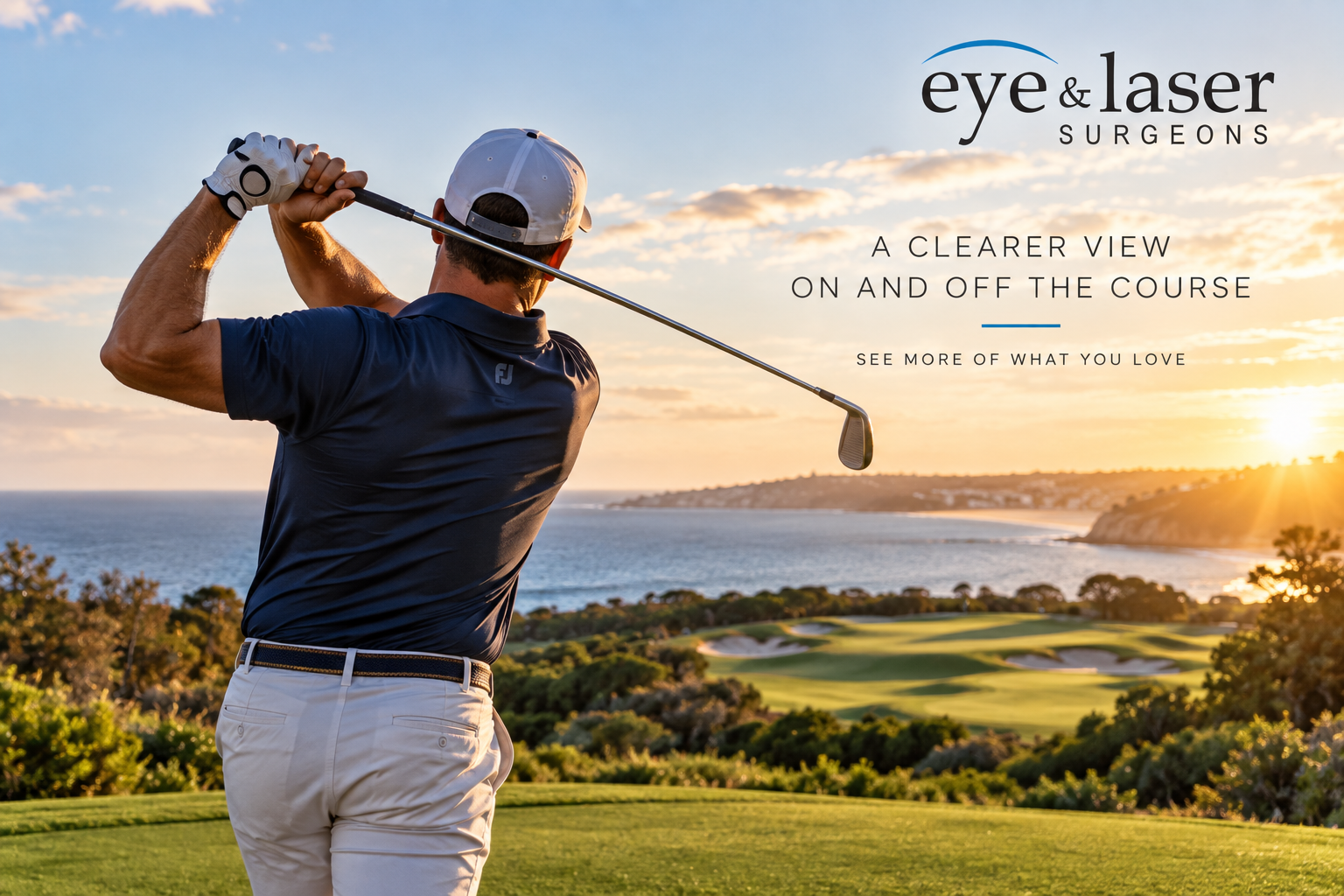
For suitable patients, personalised vision correction may reduce dependence on prescription glasses or contact lenses on and off the golf course.
Vision Correction for Golfers: In Brief
Vision correction for golfers is not one particular procedure.
Depending on your eyes, age and visual goals, appropriate options may include glasses, contact lenses, LASIK, SMILE, PRK or Implantable Contact Lenses (ICL).
As we get older, presbyopia and cataract may also influence treatment planning. Consequently, lens-based vision correction or cataract surgery may become more relevant for some people.
Golf also requires useful vision across several distances. For example, golfers may need to follow the ball at distance and then read a GPS watch or scorecard much closer to them.
Therefore, a comprehensive assessment should consider how you use your vision both on and off the golf course before treatment is recommended.
At a Glance
People considering vision correction for golf commonly ask:
- Can I play golf without prescription glasses?
- Is LASIK suitable for golfers?
- Is SMILE or PRK better for golf?
- Will I still need reading glasses?
- Why is my golf vision changing after 40?
- Can cataracts affect golf?
- Can cataract surgery reduce my dependence on glasses?
- Which cataract lens may suit an active lifestyle?
- How soon can I return to golf after eye surgery?
There is no single answer for every golfer.
Instead, the most appropriate option depends on your prescription, eye health, age, lifestyle and long-term visual goals.
Why Golfers Consider Vision Correction
For many golfers, the decision to explore vision correction begins with practical frustrations.
Glasses may work perfectly well in everyday life. However, several hours on a golf course can expose them to sweat, rain, changing temperatures and bright sunlight.
In addition, some golfers find themselves repeatedly changing between prescription glasses and prescription sunglasses as conditions change.
Glasses may also slip during physical activity.
Contact lenses can provide excellent vision too. Nevertheless, some people experience increasing dryness or discomfort after several hours outdoors, particularly in windy conditions.
None of these situations means someone needs surgery.
However, for some golfers, reducing dependence on prescription eyewear may make an active lifestyle more convenient.
That is often where the conversation about vision correction begins.
Golf Requires Vision Across Different Distances
Golf is particularly interesting because visual attention continually moves between different distances.
Distance Vision
From the tee, you may want clear distance vision to see:
- the fairway
- hazards
- bunkers
- the green
- the flight of the ball
However, distance vision is only part of the picture.
Intermediate Vision
Increasingly, golfers also use technology throughout a round.
For example, intermediate vision may be useful for:
- GPS devices
- golf watches
- rangefinders
- golf-cart displays
- phones
As a result, correcting distance vision alone may not address every visual requirement.
Near Vision
Near vision also becomes increasingly important as presbyopia develops.
For instance, golfers may need to see:
- the ball at address
- scorecards
- phones
- smaller displays
Therefore, particularly after 40, vision correction planning may need to consider several distances rather than distance vision alone.
Why Does This Matter When Choosing Vision Correction?
The most appropriate vision-correction strategy is not necessarily the one that produces the clearest possible distance vision in isolation.
Instead, we need to understand how you want your vision to function throughout your day.
A golfer may want excellent distance vision on the course. At the same time, they may spend eight hours each day working at a computer.
Another person may drive frequently at night.
Meanwhile, someone else may place greater importance on reading without glasses.
These differences matter.
For this reason, two golfers with similar prescriptions may receive different recommendations.
Reading the Green Is About More Than Seeing 6/6
A golfer can read the smallest letters on an eye chart and still experience visual difficulties on the course.
Golf takes place in a complex outdoor environment.
For example, the ball may need to be distinguished against bright sky, dark trees, fairway, rough, sand or changing shadows.
Visual quality can therefore involve more than visual acuity alone.
In addition, contrast, glare, tear-film quality and the health of the natural lens may influence how someone experiences their vision.
Importantly, this does not mean that eye surgery will improve someone’s golf.
Rather, understanding these factors helps us determine whether a visual complaint may relate to refractive error, ocular surface problems, cataract or another eye condition.
Every Golfer Is Different
Golfers have different priorities.
Someone playing socially once a month may have different needs from a person playing several rounds each week.
Likewise, a competitive golfer may have different visual priorities from someone who mainly enjoys golf as a social activity.
Age matters too.
For example, a golfer in their twenties with myopia may require a very different conversation from someone in their fifties who is beginning to rely on reading glasses.
Meanwhile, a golfer developing cataract may require another approach entirely.
For this reason, we consider:
- how often you play
- whether you compete
- your prescription
- contact lens tolerance
- your occupation
- driving
- night vision
- reading requirements
- other sports
- your age
- your future visual goals
Ultimately, the treatment should follow the patient—not the golf course.
Common Frustrations Golfers Tell Us About
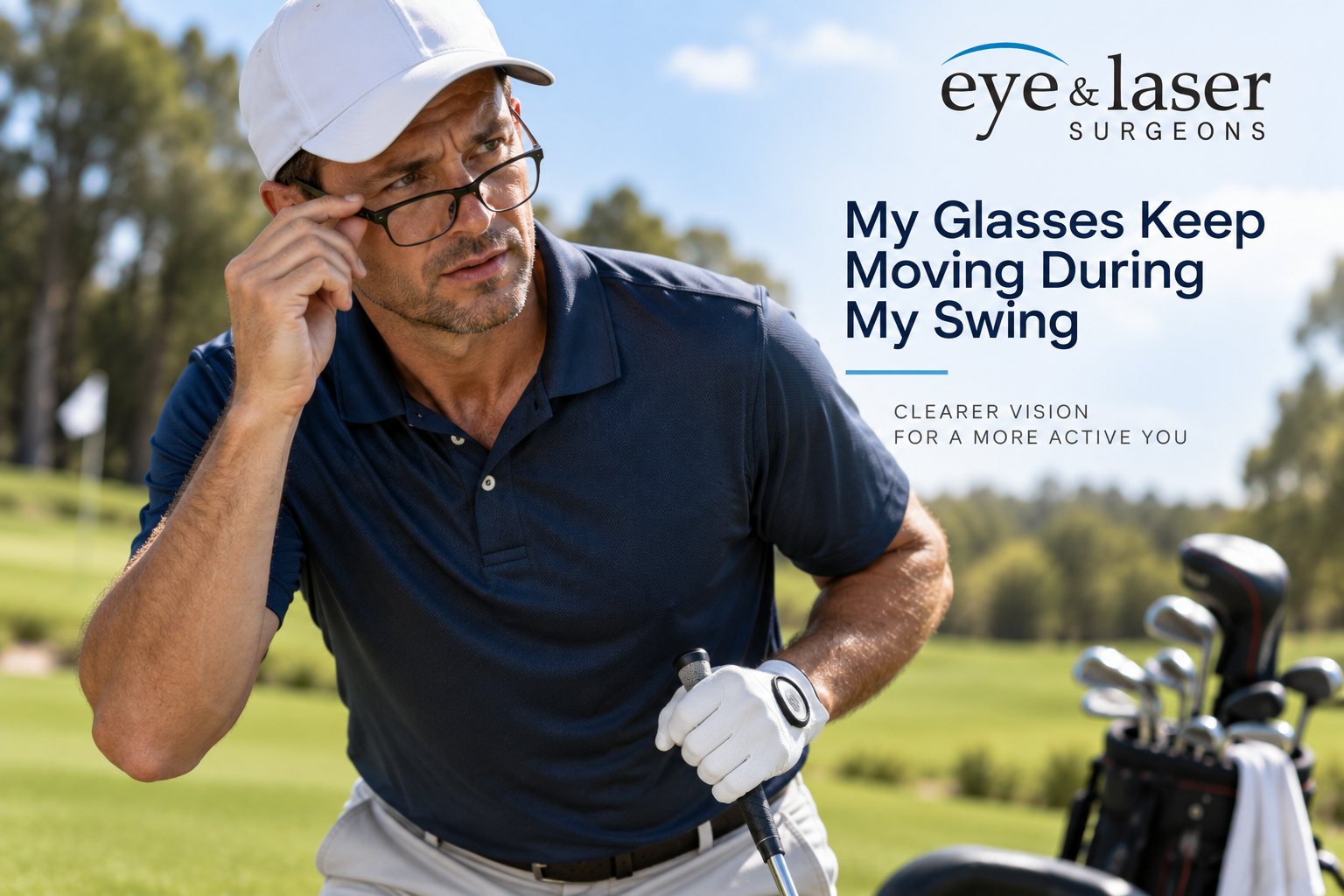
Sweat and movement can cause glasses to slip during a round. For some golfers, these practical frustrations are one reason to explore personalised vision correction.
“I’m Constantly Changing Glasses”
A golfer may arrive at the course wearing everyday prescription glasses.
Then, bright sunlight means changing to prescription sunglasses.
Later, cloud arrives. Consequently, the sunglasses may come off again.
Meanwhile, reading glasses may still be needed for a phone, GPS device or scorecard.
For some golfers, managing several pairs of glasses becomes more frustrating than the prescription itself.
“My Contact Lenses Become Uncomfortable by the Back Nine”
A round of golf can involve several hours outdoors.
Consequently, some contact lens wearers notice increasing dryness or discomfort as the day progresses.
If this occurs, we want to understand why.
Importantly, ocular surface health is an important part of refractive assessment. Therefore, dry eye should be evaluated rather than assuming surgery is automatically the solution.
Golf, Presbyopia and Vision After 40
For many golfers, this becomes one of the most important conversations.
Presbyopia is the gradual reduction in the natural lens’s ability to focus at near distances.
As a result, a golfer may still see the flag clearly but suddenly find the scorecard difficult to read.
Likewise, a GPS watch may need to be held further away. Reading glasses may also start appearing in the golf bag.
Therefore, after 40, the question may change from:
“Can you correct my distance prescription?”
to:
“How do I want to see across distance, intermediate and near?”
That is a much more useful question.
Depending on the individual, this may influence whether we discuss conventional distance correction, different refractive strategies, glasses or lens-based options.
→ Learn more about Vision Correction for Presbyopia
Golf and Cataracts
As the natural lens ages, it can gradually become cloudy. This is a cataract.
Some golfers notice progressive blur.
However, others first become aware of more subtle changes, including:
- increasing glare
- reduced contrast
- changing glasses prescriptions
- difficulty in lower light
- colours appearing less vivid
- increasing dependence on glasses
These symptoms are not unique to cataract.
For example, dry eye, refractive error and retinal conditions may produce some similar complaints.
Therefore, diagnosis comes before treatment.
If cataract is significantly contributing to the visual problem, changing glasses or performing corneal laser surgery may not address the underlying cause.
Instead, cataract surgery may become the more appropriate pathway.
Because cataract surgery replaces the natural lens, it also creates an opportunity to discuss how you would ideally like your vision to function afterwards.
Sunglasses Still Matter After Vision Correction
Reducing dependence on prescription glasses does not mean golfers should stop wearing sunglasses.
Golfers may spend several hours outdoors during a single round.
Therefore, appropriate sunglasses remain useful for:
- UV protection
- glare management
- visual comfort
- wind protection
What may change following suitable vision correction is the prescription requirement.
For example, some people may be able to use ordinary non-prescription sunglasses rather than prescription sunglasses.
It’s About More Than Golf
Golf may be the reason someone begins exploring vision correction.
However, treatment needs to support the rest of their life as well.
We also consider:
- work
- driving
- reading
- computer use
- travel
- other sports
- night vision
- long-term eye health
For example, a treatment strategy that works well on the golf course but creates difficulties for someone’s occupation would not represent good planning.
Therefore, the goal is broader.
We want to understand how you use your vision throughout your life.
Before We Talk About LASIK
Many golfers arrive expecting to discuss laser eye surgery.
Often, they already know the names LASIK, SMILE and PRK.
However, our first question is different:
What is causing the visual problem you’re trying to solve?
We then assess the eyes to understand the answer.
For a younger golfer with stable myopia, LASIK, SMILE, PRK or ICL may deserve consideration.
By contrast, a golfer experiencing presbyopia may need a different strategy.
Meanwhile, for someone developing cataract, lens-based surgery may eventually become the more appropriate pathway.
And for some people, glasses or contact lenses remain entirely appropriate.
In short: we assess first. We explain the options. Then, together, we decide what makes sense.
The Goal Is Better-Supported Vision, Not a Better Golf Score
Vision correction cannot guarantee lower scores, improved putting or better sporting performance.
That is not the purpose of treatment.
For suitable patients, however, vision correction may:
- reduce dependence on prescription glasses
- reduce reliance on contact lenses
- simplify sunglasses
- make an active lifestyle more convenient
- correct refractive error as part of a broader visual plan
Ultimately, our goal is to help your vision support the way you live—not promise that surgery will change the way you play.
How We Choose Vision Correction for Golfers
How We Assess Golfers Considering Vision Correction
Choosing vision correction begins with understanding why your vision is not working the way you want it to.
For some golfers, the issue is straightforward refractive error such as myopia, hyperopia or astigmatism.
However, other people may be experiencing dry eye, presbyopia, cataract or another change in eye health.
Therefore, we don’t begin an assessment by deciding which procedure to perform.
Instead, we begin by understanding the eyes.
We then consider how you use your vision on the golf course, at work and throughout everyday life.
This distinction matters because two golfers with similar glasses prescriptions may ultimately benefit from very different approaches.
A Comprehensive Vision Correction Assessment
A glasses prescription tells us how much refractive correction you need.
However, it does not tell us which treatment is most appropriate.
Depending on your individual circumstances, a comprehensive assessment may include:
- detailed refraction
- prescription stability
- corneal topography and tomography
- corneal thickness
- tear-film assessment
- ocular surface health
- pupil assessment
- natural lens assessment
- retinal examination
- overall eye health
- discussion of your work and lifestyle
- your current and future visual goals
Together, these findings allow us to build a more complete picture of your eyes.
Only then do we discuss which options may be appropriate.
Comprehensive Vision Correction Assessment
We Also Want to Understand Your Golf
Clinical measurements are only part of the assessment.
Equally important, we want to understand how you use your vision.
For example, we may ask:
- How often do you play?
- Do you compete?
- Do you usually play during the day?
- Do you struggle with glare?
- Do you wear prescription sunglasses?
- Are contact lenses comfortable throughout a round?
- Can you see your GPS watch or scorecard comfortably?
- Do you drive at night?
- What do you do for work?
- How important is reading without glasses?
These questions are not incidental.
Instead, they help us understand what a successful visual strategy would actually need to achieve for you.
The Ocular Surface Matters
Some golfers begin exploring refractive surgery because contact lenses have become uncomfortable.
However, contact-lens intolerance may sometimes reflect an underlying ocular-surface problem.
Dry eye can cause:
- irritation
- burning
- fluctuating vision
- intermittent blur
- contact-lens discomfort
Moreover, long periods outdoors may expose the eyes to wind, heat and dry conditions.
For this reason, we assess the ocular surface rather than simply assuming that laser eye surgery will solve contact-lens discomfort.
Where appropriate, dry-eye or tear-film problems may need to be managed before we make a final treatment recommendation.
Choosing the Most Appropriate Vision Correction Option
Many golfers begin their research by asking:
“Should I have LASIK?”
It is a reasonable question.
However, LASIK is only one of several ways to correct refractive error.
Depending on your eyes, age and visual goals, appropriate options may include:
- glasses
- contact lenses
- LASIK
- SMILE
- PRK
- Implantable Contact Lenses (ICL)
- lens-based vision correction
- cataract surgery where cataract is present
Therefore, our role is not to decide which procedure we prefer.
Our role is to determine which options are appropriate for you and explain the differences clearly.
LASIK for Golfers
LASIK reshapes the cornea to correct refractive error.
For suitable patients, it may reduce dependence on glasses or contact lenses and generally provides relatively rapid visual recovery.
For a golfer, that may mean less reliance on prescription glasses or prescription sunglasses during a round.
However, the fact that someone plays golf does not make LASIK the preferred procedure.
Suitability depends on factors including:
- prescription
- corneal shape
- corneal thickness
- ocular surface health
- age
- overall eye health
Therefore, LASIK should be considered within the context of the complete assessment rather than lifestyle alone.
SMILE for Golfers
SMILE is another form of laser vision correction.
It may be appropriate for selected people with myopia and certain degrees of astigmatism.
The procedure differs technically from LASIK. However, the important question for the patient is not which technology sounds newer or more appealing.
Instead, we ask:
Which procedure best matches the characteristics of these particular eyes?
For some golfers, SMILE may be appropriate.
For others, LASIK, PRK, ICL or continuing with glasses or contact lenses may make more sense.
PRK for Golfers
PRK corrects refractive error at the surface of the cornea.
For selected patients, it may be considered when corneal characteristics or other clinical factors influence treatment selection.
However, visual recovery is generally slower than with LASIK.
Consequently, timing deserves consideration.
If you have:
- an important golf tournament
- a golf holiday
- significant work commitments
- upcoming travel
we can discuss these plans when considering the timing of treatment.
The aim is not to rush recovery to fit the golf calendar.
Instead, treatment should be scheduled around appropriate healing.
Implantable Contact Lenses (ICL)
Not every person seeking freedom from glasses requires corneal laser surgery.
For some people, particularly those with higher prescriptions or where corneal laser treatment is less suitable, an Implantable Contact Lens (ICL) may deserve consideration.
An ICL is placed inside the eye while the natural lens remains in place.
Therefore, unlike LASIK, SMILE and PRK, it does not correct refractive error by reshaping the cornea.
However, ICL is intraocular surgery and requires detailed assessment before treatment.
For the appropriate patient, it provides another pathway within the broader spectrum of refractive surgery.
How Age Changes the Decision
Age is not simply a number on the consultation form.
Instead, it can fundamentally change what we are trying to achieve.
A younger golfer with stable myopia may primarily want clear distance vision without glasses.
By comparison, a golfer in their forties or fifties may also need to consider:
- reading
- computer vision
- phones
- GPS watches
- scorecards
- night driving
As a result, treatment planning becomes less about correcting one prescription and more about deciding how vision should work across several distances.
That is why presbyopia deserves a separate discussion.
Presbyopia and Golf
Presbyopia occurs as the natural lens gradually loses its ability to change focus for near objects.
Consequently, reading glasses become increasingly common from the forties onwards.
For golfers, this may create an interesting contrast.
Distance vision may remain excellent.
However, the scorecard becomes harder to read.
The golf watch may need to move further away.
Likewise, the phone may require reading glasses.
At this stage, correcting both eyes perfectly for distance may not necessarily address every visual goal.
Therefore, we discuss how you would ideally like to see at distance, intermediate and near before recommending treatment.
Depending on the individual, options may include:
- glasses
- contact-lens strategies
- selected laser vision strategies
- lens-based approaches where appropriate
There is no single solution that suits everyone.
Vision Correction for Presbyopia
When Cataract Changes the Treatment Pathway
Sometimes a person considering laser eye surgery discovers that refractive error is not the only reason their vision has changed.
For example, cataract may gradually affect the clarity of the natural lens.
Symptoms may include:
- progressive blur
- glare
- halos
- reduced contrast
- changing prescription
- difficulty in lower light
However, these symptoms can have several causes.
Therefore, examination comes before diagnosis, and diagnosis comes before treatment.
If cataract is significantly contributing to the visual problem, performing corneal laser surgery may not address the underlying cause.
Instead, cataract surgery may become the more appropriate pathway.
Understanding Cataracts and Cataract Surgery
Cataract Surgery for Golfers
Cataract surgery removes the cloudy natural lens and replaces it with an intraocular lens, or IOL.
However, modern cataract planning involves more than simply removing the cataract.
Once we are replacing the natural lens, we also need to discuss how you would ideally like your vision to work afterwards.
For a golfer, that may involve questions such as:
- How important is distance vision?
- Do you want to see a GPS watch comfortably?
- How important is reading without glasses?
- Do you drive at night?
- Do you have astigmatism?
- Are you comfortable wearing reading glasses?
- What other activities matter to you?
These questions help define your visual priorities.
Which Cataract Lens Is Best for Golfers?
There is no single “best cataract lens for golfers.”
That is an important point.
Different intraocular lens designs provide different optical characteristics and involve different trade-offs.
Depending on the individual, we may discuss options such as:
- monofocal lenses
- toric lenses for appropriate astigmatism
- extended-depth-of-focus strategies
- multifocal or trifocal strategies where appropriate
However, the widest range of vision is not automatically the best choice for every person.
For example, someone who frequently drives at night may have different priorities from someone whose main goal is reducing dependence on reading glasses.
Likewise, underlying corneal or retinal health may influence which lens technologies deserve consideration.
Therefore, lens selection should follow assessment and discussion—not marketing claims about a particular lens.
Distance, Intermediate and Near Vision After Cataract Surgery
This is where the golf analogy becomes particularly useful.
Imagine the sequence:
fairway → green → ball → GPS watch → scorecard
Each requires vision at a different distance.
Therefore, when planning cataract surgery, it is useful to understand which of these visual ranges matter most to you.
Some people prioritise distance vision and are comfortable using reading glasses.
Others would like greater independence across intermediate or near distances.
However, every optical strategy has benefits and limitations.
Our role is to explain those differences so that you can make an informed decision.
What About Astigmatism?
Astigmatism can affect visual clarity at several distances.
Depending on its type and magnitude, it may be addressed in different ways during refractive or cataract surgery.
For example, some patients undergoing cataract surgery may be suitable for a toric intraocular lens.
However, not every person with astigmatism needs the same approach.
Therefore, accurate measurement and individual planning are important.
Understanding astigmatism and laser eye surgery for astigmastism
Returning to Golf After Laser Eye Surgery
Golfers commonly ask:
“When can I play again?”
The answer depends on:
- the procedure performed
- healing
- environmental conditions
- your individual recovery
- Dr Sharma’s advice
For some people, light activity may resume relatively quickly.
However, a golf course can involve wind, dust, bright sunlight and several hours outdoors.
Therefore, returning to golf should follow your postoperative plan rather than a generic timetable found online.
Recovery After Vision Correction
Returning to Golf After Cataract Surgery
The same principle applies after cataract surgery.
Many people are keen to return to golf because it forms an important part of their routine.
However, recovery should not be rushed.
Dr Daya Sharma will advise when it is appropriate to return based on:
- healing
- visual recovery
- the eye that was treated
- planned treatment of the other eye
- your overall circumstances
In addition, early postoperative care may involve avoiding certain activities while the eye heals.
Therefore, individual advice should take priority over a fixed calendar date.
Recovery After Cataract Surgery
Sunglasses and Eye Protection Still Matter
Reducing dependence on prescription glasses does not eliminate the need for appropriate sunglasses.
Golfers may spend several hours outdoors during each round.
Therefore, sunglasses remain useful for UV protection, glare management and comfort.
After suitable vision correction or cataract surgery, some people may simply be able to use non-prescription sunglasses instead of prescription versions.
That can be convenient.
However, the protective role of the sunglasses remains.
Looking Beyond the Next Round
A good treatment decision should not be based only on next weekend’s golf.
Instead, we consider how your vision may need to function for years to come.
For a younger golfer, maintaining future options may matter.
Meanwhile, someone approaching presbyopia may need to consider reading and intermediate vision.
For another person, cataract may already be changing the treatment pathway.
Ultimately, the most appropriate recommendation balances your current goals with the long-term health and visual needs of your eyes.
Shared Decision-Making
At Eye & Laser Surgeons, we believe every patient deserves to understand the appropriate options before deciding whether to proceed with treatment.
Therefore, our role is to explain:
- potential benefits
- limitations
- risks
- alternatives
- expected recovery
- future visual considerations
- and the option of continuing with glasses or contact lenses where appropriate
Only then do we make the decision together.
The aim is not to find the procedure with the most impressive name.
Instead, it is to find the approach that best matches your eyes, your lifestyle and your long-term visual goals.
Frequently Asked Questions About Vision Correction for Golfers
Can golfers have laser eye surgery?
Yes, many golfers may be suitable for laser eye surgery. However, playing golf does not determine whether LASIK, SMILE or PRK is appropriate.
Instead, suitability depends on factors such as your prescription, corneal shape and thickness, ocular surface, age and overall eye health.
Therefore, a comprehensive vision correction assessment should come before choosing a procedure.
Is LASIK suitable for golfers?
LASIK may be suitable for some golfers who would like to reduce their dependence on prescription glasses or contact lenses.
For example, some people appreciate being able to wear ordinary sunglasses rather than changing between prescription glasses and prescription sunglasses during a round.
However, LASIK is not automatically the best option for a golfer.
Your eyes—not your sport—should determine whether LASIK deserves consideration.
Is LASIK, SMILE or PRK better for golf?
There is no single procedure that is best for every golfer.
LASIK, SMILE and PRK correct refractive error in different ways. In addition, their indications and recovery profiles differ.
Therefore, the appropriate procedure depends on your eyes, prescription, ocular surface, age and visual goals.
Our LASIK vs SMILE vs PRK comparison explains these procedures in greater detail.
Will laser eye surgery improve my golf?
Laser eye surgery is designed to correct refractive error. It cannot guarantee better putting, lower scores or improved sporting performance.
However, for suitable patients, reducing dependence on prescription glasses or contact lenses may make playing golf more convenient.
The goal is therefore better-supported vision, not better sporting performance.
How soon after LASIK can I play golf?
Recovery varies between individuals.
Although many people return to everyday activities relatively quickly after LASIK, golf can involve several hours outdoors with exposure to wind, dust and bright sunlight.
Therefore, Dr Sharma’s individual postoperative advice should take priority over a generic return-to-golf timetable.
→ Learn more about Recovery After Vision Correction
Can I play golf after PRK?
Yes. However, PRK generally has a slower visual recovery than LASIK.
Consequently, returning to golf may require more planning, particularly if you have an upcoming tournament, golf holiday or other commitment.
When possible, we recommend planning elective surgery around appropriate healing rather than trying to fit recovery around an important event.
Will I still need sunglasses after vision correction?
Yes.
Reducing dependence on prescription glasses does not remove the need for UV protection or glare management.
Instead, some people may find that they can use ordinary non-prescription sunglasses after suitable vision correction.
Appropriate sunglasses remain valuable during prolonged outdoor activities such as golf.
Why is my golf vision changing after 40?
Often, the first age-related change is presbyopia.
As the natural lens becomes less flexible, the eye gradually loses some ability to focus at near distances.
As a result, you may still see the fairway clearly while finding your scorecard, phone or GPS watch increasingly difficult to read.
Therefore, vision correction after 40 often requires us to consider distance, intermediate and near vision rather than distance correction alone.
→ Learn more about Vision Correction for Presbyopia
Will I need reading glasses after laser eye surgery?
Possibly.
Laser eye surgery does not stop the natural ageing of the eye or prevent presbyopia.
Therefore, someone who has excellent distance vision after refractive surgery may still require reading glasses as near focusing changes with age.
Depending on your eyes and visual priorities, different strategies may be discussed during your assessment.
However, no single approach is appropriate for everyone.
Can cataracts affect my vision on the golf course?
Yes.
Cataracts can gradually affect visual quality as the natural lens becomes cloudy.
Some people notice increasing blur. However, others first notice glare, reduced contrast, difficulty in lower light or frequently changing glasses prescriptions.
These symptoms are not specific to cataract.
Therefore, examination is important before deciding what is causing the change.
If cataract is contributing significantly, cataract surgery rather than corneal laser vision correction may become the appropriate pathway.
Can cataracts make it harder to follow a golf ball?
A cataract may reduce clarity or contrast and, in some people, make visually demanding outdoor tasks more difficult.
However, difficulty following a golf ball does not automatically mean you have cataracts.
Refractive error, ocular surface problems, retinal conditions and other causes may also affect visual quality.
For this reason, the underlying cause should be identified before treatment is recommended.
Can cataract surgery reduce my dependence on glasses for golf?
Cataract surgery removes the cloudy natural lens and replaces it with an intraocular lens.
During treatment planning, we can also discuss your refractive goals.
For example, a golfer may prioritise distance vision while remaining comfortable using reading glasses. Another person may place greater importance on intermediate or near vision.
Consequently, cataract surgery creates an opportunity to discuss how you would ideally like your vision to function afterwards.
However, the degree of spectacle independence varies and cannot be guaranteed.
→ Learn more about Cataract Surgery
Which cataract lens is best for golfers?
There is no single best cataract lens for golfers.
Different intraocular lens designs provide different ranges and qualities of vision, and each has potential advantages and limitations.
Depending on your eyes and priorities, discussion may include:
- monofocal lenses
- toric lenses where astigmatism is relevant
- extended-depth-of-focus options
- multifocal or trifocal options where appropriate
Importantly, the lens offering the widest advertised range of vision is not automatically the most appropriate lens.
For example, someone who frequently drives at night may have different priorities from someone whose main goal is reducing dependence on reading glasses.
Therefore, lens selection should follow a comprehensive assessment and informed discussion.
→ Explore Intraocular Lens Options
How soon after cataract surgery can I play golf?
Return to golf depends on your individual recovery and Dr Sharma’s advice.
Although many people are keen to return quickly, golf involves more than simply walking.
It can involve bending, swinging, several hours outdoors and exposure to wind, dust and sunlight.
For this reason, recovery should not be rushed.
Dr Shanel Sharma or Dr Daya Sharma will explain when it is appropriate to return based on how your eye is healing.
→ Learn more about Recovery After Cataract Surgery
Vision Correction for Golfers: Key Points
If you’re a golfer considering vision correction, the most important points are:
- Golf requires useful vision across distance, intermediate and near ranges.
- Glasses and contact lenses remain excellent options for many people.
- LASIK is only one form of vision correction.
- SMILE, PRK and ICL may be appropriate for selected patients.
- Presbyopia increasingly influences treatment planning after 40.
- Cataract may change the appropriate treatment pathway later in life.
- Cataract surgery also creates an opportunity to discuss refractive goals and intraocular lens options.
- Sunglasses remain important after refractive or cataract surgery.
- Vision correction cannot guarantee improved golf performance.
- The most appropriate treatment depends on your eyes, lifestyle and long-term visual goals.
Explore the Eye & Laser Knowledge Centre
Rather than presenting one long list of links, I would divide the related pages into three semantic groups.
Refractive Surgery & Vision Correction
Laser Eye Surgery Sydney
Start with our comprehensive guide to laser vision correction.
Vision Correction Assessment
Understand how we assess your eyes before recommending treatment.
LASIK | SMILE | PRK | ICL
Explore the individual refractive surgery options.
Vision Correction for Presbyopia
Learn how treatment planning changes as near focusing declines.
Cataract & Lens Surgery
Understanding Cataracts
Learn what cataracts are and how they can affect visual quality.
Cataract Surgery
Understand assessment, treatment and recovery.
Intraocular Lens Options
Explore monofocal, toric, EDOF and multifocal lens strategies.
Recovery After Cataract Surgery
Understand what to expect after treatment.
Sport & Active Lifestyles
Vision Correction for Athletes & Sports Professionals
Vision Correction for Work, Sport & Active Lifestyles
Vision Correction for Tennis Players
Vision Correction for Cyclists
Vision Correction for Swimmers & Triathletes
Vision Correction for Sailors & Yachtsmen
This gives Google and AI systems an explicit knowledge graph rather than a random collection of related links.
Your Vision Should Support the Way You Live
Whether you play competitively, enjoy a weekly round with friends or simply value an active lifestyle, your visual requirements are individual.
For some golfers, glasses or contact lenses provide everything they need.
For others, reducing dependence on prescription eyewear may offer greater convenience.
Meanwhile, as vision changes with age, presbyopia or cataract may introduce entirely different considerations.
Therefore, choosing vision correction should begin with understanding the problem—not choosing the procedure.
At Eye & Laser Surgeons, we believe every patient deserves to understand all appropriate options before making an informed decision.
Our role is to assess your eyes, understand how you use your vision and explain the potential benefits, limitations, risks and alternatives of the appropriate options.
Then, together, we can decide what best supports your vision today and your long-term eye health.
Could Vision Correction Suit Your Lifestyle?
If glasses, contact lenses or changing vision are affecting the way you enjoy golf or everyday life, our 2-minute Vision Correction Test is a simple place to start.
Answer a few questions about your vision, age and lifestyle to explore which options may be worth discussing with our team.
The test does not replace a comprehensive eye examination or determine whether you are suitable for surgery.
Instead, it can help you understand the next questions to ask.
Take the 2-Minute Vision Correction Test
Explore. Understand. Decide.
Ready to Understand Your Eyes?
A comprehensive assessment is the next step if you would like personalised advice.
During your consultation, we can discuss:
- your prescription
- corneal health
- ocular surface
- natural lens health
- presbyopia
- cataract where relevant
- distance, intermediate and near vision
- golf and other activities
- work and driving
- long-term visual goals
- appropriate treatment options